The medical disadvantages facing American women (especially educators)

In the past 2+ years in the US, the medical industry has been through a draining and dramatic strain due to the COVID-19 pandemic. Doctors and nurses were overworked, lauded as heroes, were at the center of both praise and criticism due to COVID and COVID-deniers, and have faced incredible and unprecedented struggles. So, in no way do I mean to disparage the medical field. Doctors and nurses are a vital necessity for the health and wellness of our society at large. The incredible amount of knowledge, training, tuition money, grueling residencies, and other parts of being a physician, surgeon, nurse, nurse practitioner, pharmacist, or hospital employee inspire a lot of awe. However, as a woman and as a school leader, I have to say that a profession that claims to be based on “doing what’s best for patients”, often falls very short in not only it’s overall treatment of women (especially minority women), but an important subset of women – educators.

On paper, medical doctors and educators have a lot in common. Both are professions that are actually made up of a MAJORITY of women. Both professions are filled with women with advanced degrees who face a pay gap between themselves and their male colleagues (especially when those women are women of color). However, the difference in the amount of public respect, pay, and the ability to maintain a work-life balance are often vast. While many nurses and doctors at hospitals work grueling shifts, they don’t often take tremendous amounts of work home with them. Growing up, I watched my mother become an award-winning nurse at the University of Chicago. She’s won every nursing award that the hospital gives. She has an incredible work ethic and was intensely devoted to her work, her patients, their families, and her coworkers for her entire career. That being said, as a full-time nurse that earned generous overtime pay on holidays or for staying late, she never once took a piece of paperwork home. She worked 3, 12-hour shifts per week plus every-other weekend. She earned a great living, had a good work-life balance, and when she was home, she was HOME. The lifesaving, incredibly brilliant trauma-surgeon that saved my ex-husband’s arm from amputation works 2, 16-hour shifts a week (which might be extended due to complex surgeries), and every-other weekend (plus being on-call while other surgeons are on vacation/out of the office, etc.) Of course, both of these examples are anecdotal and were HOSPITAL employees at the busy University of Chicago Hospital – not private practice or local doctors’ offices. The vast majority of my current frustration with the medical industry is actually NOT with hospitals in general, but rather with local medical offices.

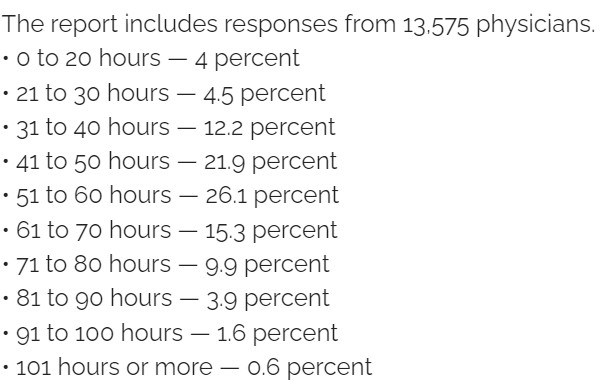
But before we get into all of that – let’s look at some demographic data of these female-majority professions. According to the research on www.zippia.com, regarding medical doctors in the United States, 53% are female with average pay varying per region between $120k and $192k (see graphics below). Obviously, those with additional degrees, more specialized areas of expertise, etc. could exceed this amount. Additionally, a report by The Physician’s Foundation released in 2018 found that a majority of doctors worked 51-60 hours per week (see graphic below).
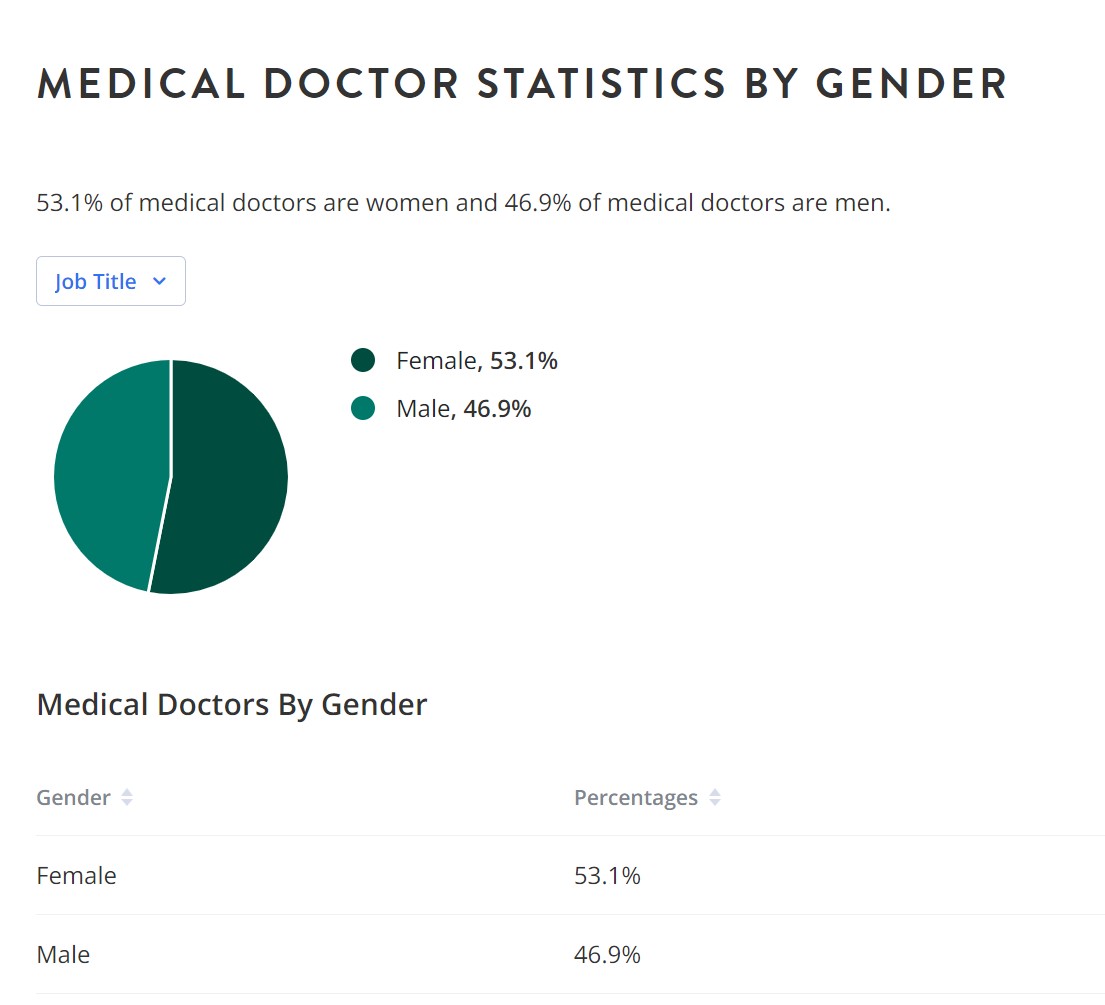
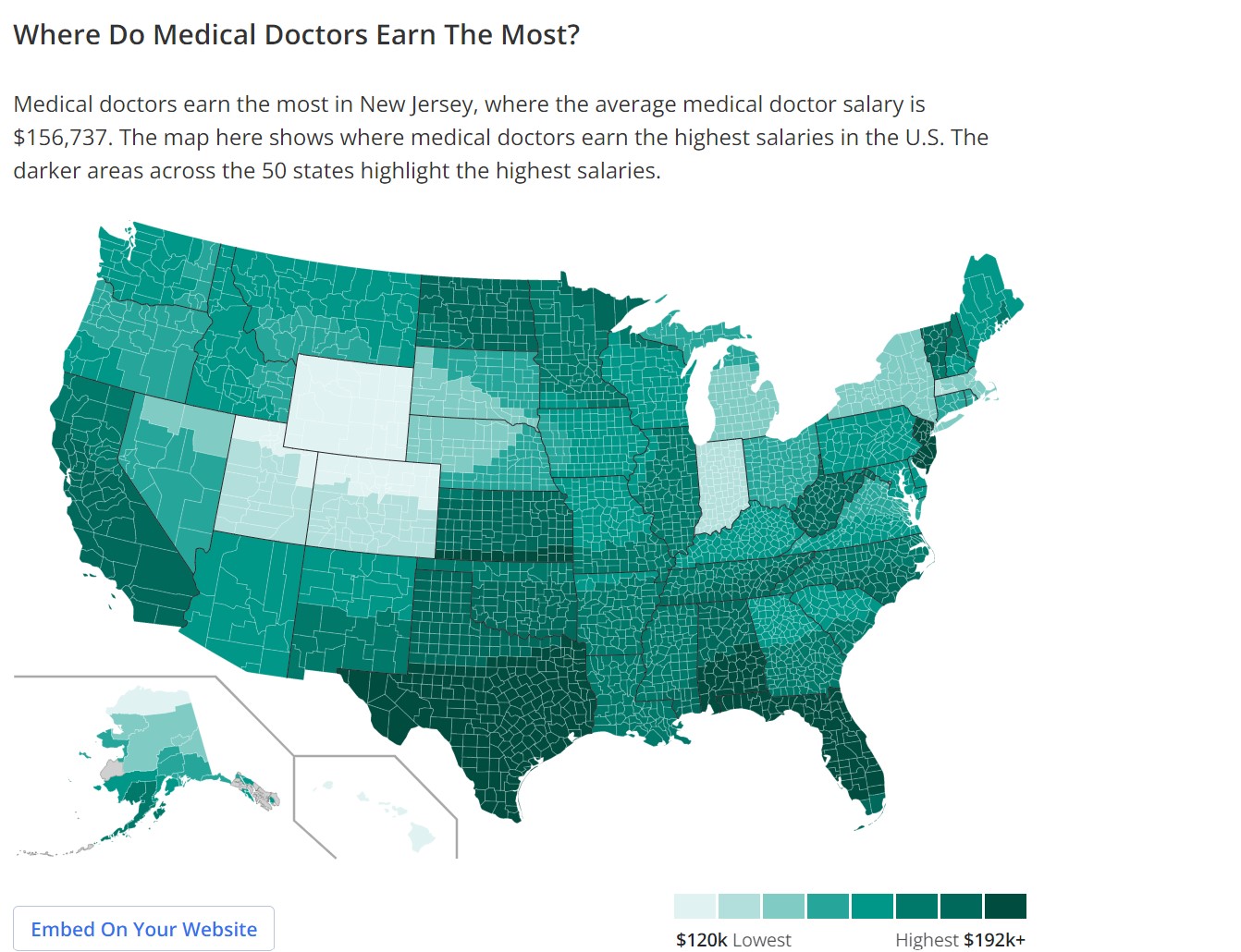
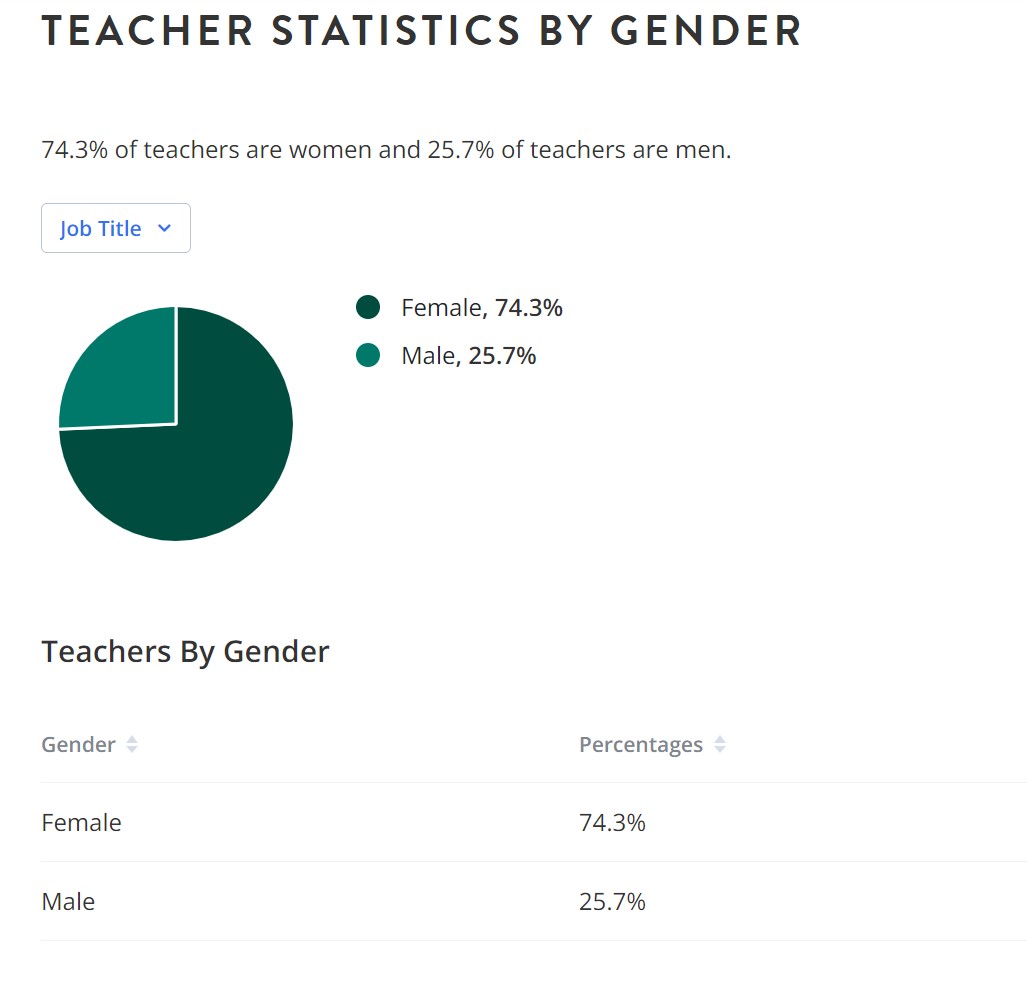
Let’s compare this same information for teachers (ALSO a highly educated, majority-women profession that has a pay differential between males and females). Teachers are 74% female, with an average salary (depending upon region) between $31k-$63+k (see graphic below), and per recent research published in Education Week, the average teacher works about 54 hours per week (read the full article on how teachers’ workweeks break down here). What a STARK difference in pay for somewhat similar hours. (And these statistics do NOT include the piles of paperwork that any of these educators take home and work on on their own time).
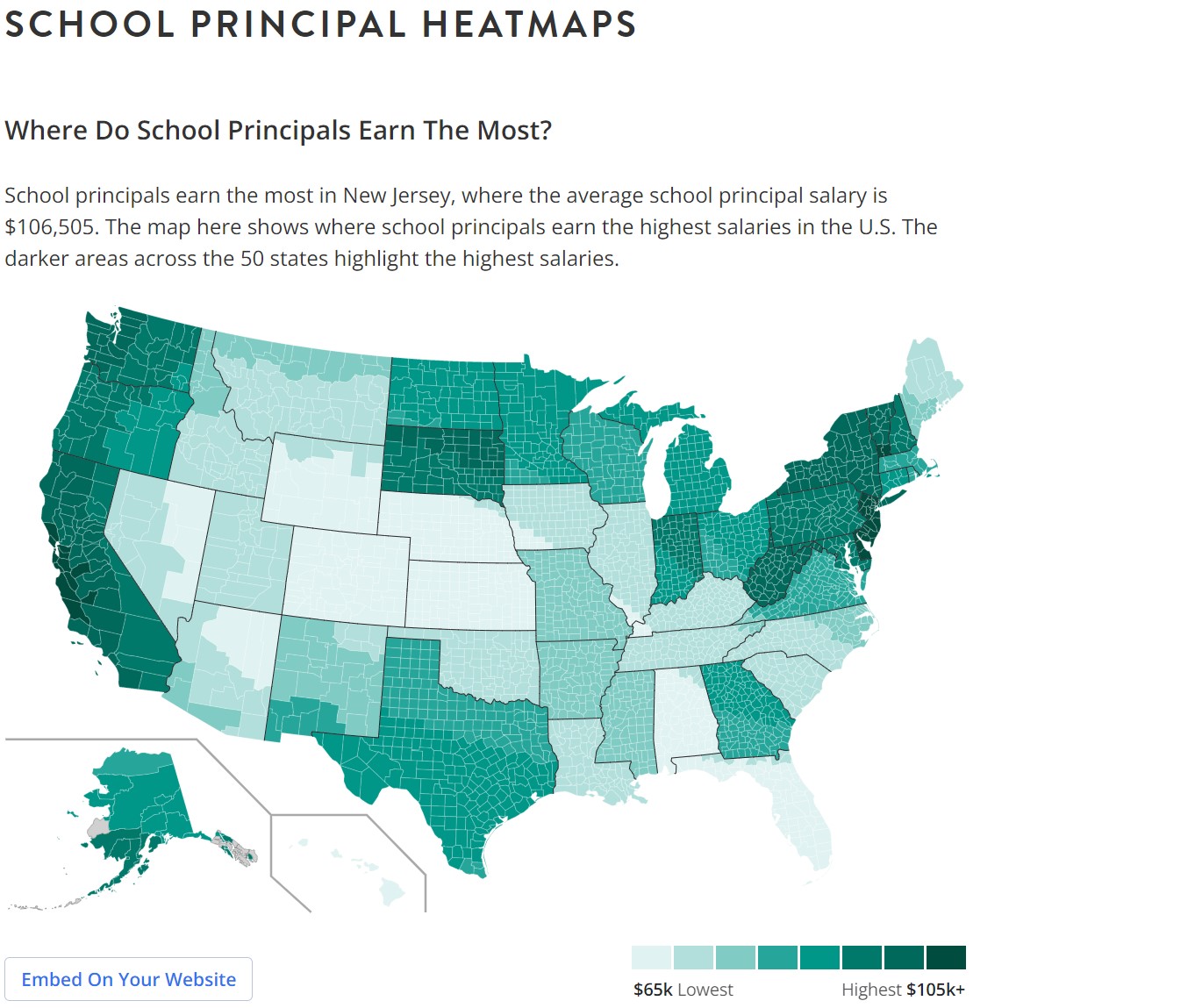
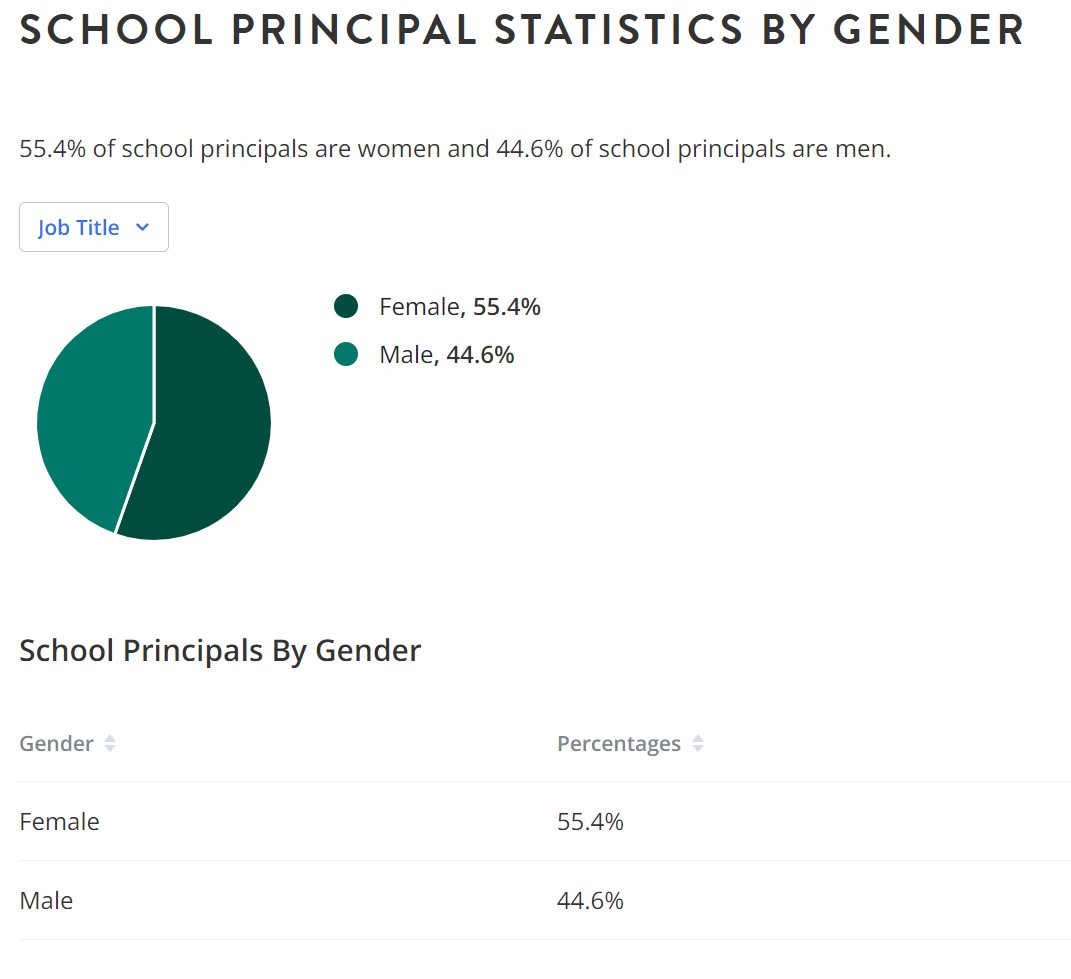
Ok, ok – maybe comparing medical doctors to teachers isn’t really fair. After all, aren’t medical doctors required to have much more education, training, and experience than the average classroom teacher? So, let’s talk about school principals. ALSO, a female-dominated field (but only if you lump all schools together though. A VAST majority of high schools are led by men and since there are many more elementary schools and the majority of THOSE are led by women it sort of skews the data). Female school principals account for 55% of all school principals and make an average (regional variations) of $65k-$105+k (see graphics below). Additionally, the average school principal reported working about 60 hours a week BEFORE the pandemic; but in my experience, a follow-up study with updated numbers just might show this being AT LEAST 60 hours a week.
Why do I bring any of this up at all? Well because I’m a woman who needs to see a gynecologist. And good luck doing that if you aren’t a woman who can go to the doctor between 9 am and 3 pm. Recently, I (tried to) make an appointment with my gynecologist. She only works between 9 am and 3 pm. So, an early morning OR an afternoon appointment would mean that I would have to take off of work (since I can’t go for a 7 am appointment and just come in a bit late OR leave with the students at 3:15 for a 4 pm appointment as neither of those are options). Even taking a half-day isn’t possible unless I can get guaranteed an on-time appointment at 10 am and get to my building by 11:30; or get a guaranteed appointment between 12:30 and 2:30 so I can stay until 11:30 (the cutoff time for “half-day).

Being the educator that I am – I don’t like to take time off when students are in the building. Although it’s less of a big deal now that I’m an administrator – it’s still not ideal. I remember the pressure (some put on myself by myself and some put on me by students, parents, and administrators) to not take off of work. “We only have 180 days with students – everyday counts”, “not enough learning happens when there’s a sub”, “it impacts the whole building when an adult is out”. And all of those things are true. So, like MANY educators, I RELY on early-morning, late-afternoon, weekend, or evening appointments. Failing those options, I pack my Thanksgiving, winter, spring, and summer breaks chock full of eye doctor, annual physical, gynecologist, blood test, mammogram, and dental appointments. Frankly, it sucks, and I’ve always resented having to line up tons of appointments on the rare days off of work that I get all to myself. I’ve always preferred the early-morning, late afternoon, or weekend appointments so that I don’t NEED to give up vacation time, impact my students, or burden my coworkers so that I can sit in waiting rooms. However, this has become less and less of an option for me lately. Every time I call an office to try to get an early, late, or weekend appointment I am told, “oh the doctor no longer has any evening, weekend, or early morning hours”. So begrudgingly, I mentally prepare myself to give up Winter, Spring, or Summer break days. And lo and behold, apparently all the doctors are also taking off during all of the school breaks as well so they can hang out with their own children. And I GET IT. I understand the desire to take a family vacation, spend time with family, etc. But those same doctors ALSO have a certain expectation that their own children will have teachers on a daily basis when they go to school. They have a certain expectation that Open Houses, Back to School Bashes, Parent-Teacher Conferences, School Tours, and Meet the Teacher Nights will take place outside of those teachers’ and administrators’ paid hours. So why don’t those same doctors have the occasional night, weekend, late afternoon, or “around the holidays” hours? Don’t the women who care for doctors’ children deserve the same convenience that their children’s teachers give to them?

I am ALL FOR work-life balance. And I am not suggesting that any overworked and stressed out medical professional works MORE hours themselves. I am asking why more of them won’t work SMARTER? For example, even if the cost is a little higher, I will remain an avid patient at my dentist’s office until the end of time. They are closed every Monday and open at noon every Tuesday. They are open Tuesdays from noon-8pm and Wednesdays-Fridays from 8-4PM and every other Saturday from 7am-noon. The 4 dentists take turns on who works on Saturdays and Tuesday evenings so that they each only work 1 in every 4 evenings or Saturdays. As a result, I never have to take off of work to take care of my dental health. This includes their endodontist! I have had 2 root canals at 6 PM and haven’t had to take off of work. It meant that my students, my teachers, and the other administrators in my building didn’t have to feel my absence and I also remained healthy enough to keep working because the dental issue was taken care of before it turned into an infection.

How many average workers (teachers or otherwise) want to take off of work on a random Tuesday morning to get a physical or an eye doctor appointment? (Especially if you get paid by the hour and will lose income?) Survey your patients to see what times would be the most convenient for them and eliminate the times/days that are less popular and maybe close on Monday and Tuesday but work Wednesday evenings and Saturday mornings. Split up those days with the other doctors in your office/network. I guarantee all of the shift workers and teachers and school administrators that can’t take off of work on a Wednesday at 1 PM would be grateful. A person that is willing and able to receive preventative or basic care at a convenient time would be a loyal patient. Regular, everyday medical care is what prevents more serious illness and keeps people healthy. Imagine the long-term impacts on children whose teachers have medical issues that aren’t diagnosed early and result in a leave-of-absence? When I asked the receptionist at my gynecologist’s office what I could do if I had a serious medical concern and they couldn’t get me a first-thing-in-the-morning appointment, her response was “I dunno, go to the emergency room, I guess. We tell people to just take off of work.” I was so annoyed that I looked for another doctor and when I called his office was told that there was a 4-month waiting list for new patient appointments. Imagine the uproar from doctors (or any parents) if schools said, “sorry but we only do parent-teacher conferences from 9-3 and we don’t have events like Open House outside of the school day – just take off of work.”

If there is one thing that the COVID-19 pandemic has done to transform the world of work, it was adding flexibility to the workplace. Many industries are allowing for flexible hours, working from home, hybrid work, or a combination of all of the above. Even the medical industry has embraced the teledoc system for more minor medical conditions that don’t require testing or in-person interaction. Many of the “essential workers” such as retail workers, school employees, many medical employees, and those involved in the transportation industry haven’t gained any of this flexibility or the option to work from home or split our hours. As a result, educators still have to make the difficult call of, “should I leave my students today and impact their education to get a pap smear/blood test/cancer screening from a doctor that won’t work before or after school, on the weekend, or during school breaks?” or “Should I just put it off?” Either way – those doctors’ (and other people’s children) will be impacted. Either the teacher will miss a day, or they might actually get ill and miss potentially a lot more days, or worst-case scenario they’ll have to have a long-term sub due to a serious illness or even death). Meanwhile, those same doctors and parents expect those educators to be present outside of their contracted hours to support them and their children through athletic games, Open Houses, conferences, parades, events, Science Fairs, etc. We can talk all day about “self-care” and how if you have the PTO that you should take it when you need it – but educators will ALWAYS have the added pressure of how this will impact the learning of their students. Many are more than willing to take care of their personal business on their personal time – but they can’t find doctors that will accommodate them. So, doctors, I beg you to take your children’s teachers, principals, paraprofessionals, and other school staff (as well as essential workers in other industries that don’t have flexibility) into your planning of your office hours and operational systems. No one is asking you to work more, just work differently. Consider the health of the people that care for your children and how your children might be impacted by missing their teacher (who is willing to come and see you at 4 PM or on Saturday morning with no impact on your child’s education).

Women’s health in general in this country is in a sad state of affairs. There simply aren’t enough OB/GYN’s and in my anecdotal experience, the quality of a lot of the gynecologists that myself and the women in my life have come across have left a lot to be desired. I don’t have data to back this up – it’s just a feeling that I’ve developed over the years; but a lot of gynecologists don’t seem all that interested in women’s actual health. MANY of them love babies, pregnancy, pregnant women, and helping women give birth. It’s not only obvious by the decorations in their office, their excitement when a pregnant woman walks through their doors, but it also shows in what kind of care that their office hours show has value. Once I FINALLY got an appointment at the gynecologist (2 months AFTER I was due to go AND had to take off of work), I was at the counter paying my co-pay and waiting for the receipt to be handed to me. While I was standing there, I overheard the other secretary get a phone call from a newly pregnant mom who was calling to make an appointment. She was fit in THAT WEEK with no notice. But when I had called with a serious MEDICAL CONCERN it took me 2 months to get that same courtesy of an appointment. (Because the doctor only blocks out 2 hours a day between 10-12 for non-pregnancy related appointments). If this had been a one-time thing, then maybe I could consider it a fluke. But at the same gynecologist, 2-years prior (after my having to take off of work to have a procedure done due to the lack of early morning or late afternoon appointments), I was called AS I WAS PULLING INTO THE PARKING LOT to be told “the doctor is with a patient in labor at the hospital can you come back in 2 hours?” A procedure that I was having to TRY TO PREVENT cancer. To add insult to injury, the procedure wasn’t successful, and I needed it repeated. Again, I took time OFF OF WORK to come in for the re-do when it was convenient for the doctor. 2 days before the procedure the doctor’s office called me to tell me “The doctor has to reschedule you’ll need to come in on the 10th instead.” In a total Karen moment, I told the secretary that that would be impossible as I’d already taken the time off – whomever was covering for the doctor when her patients went into labor would have to do the procedure. She informed me “she doesn’t have anyone to cover. All the appointments just need to be rescheduled. The other doctors in this office have their own appointments scheduled already.” (So do all of the teachers that I have to pull from their breaks to cover the classes that have no sub, and we make it work even though it’s not even a little bit ideal). I was so nervous and worried that I cried on the phone. She took pity on me and told me if I promised to be in 25 minutes earlier than I’d originally planned then the doctor would have enough time to do the procedure and go to the hospital for the C-section.

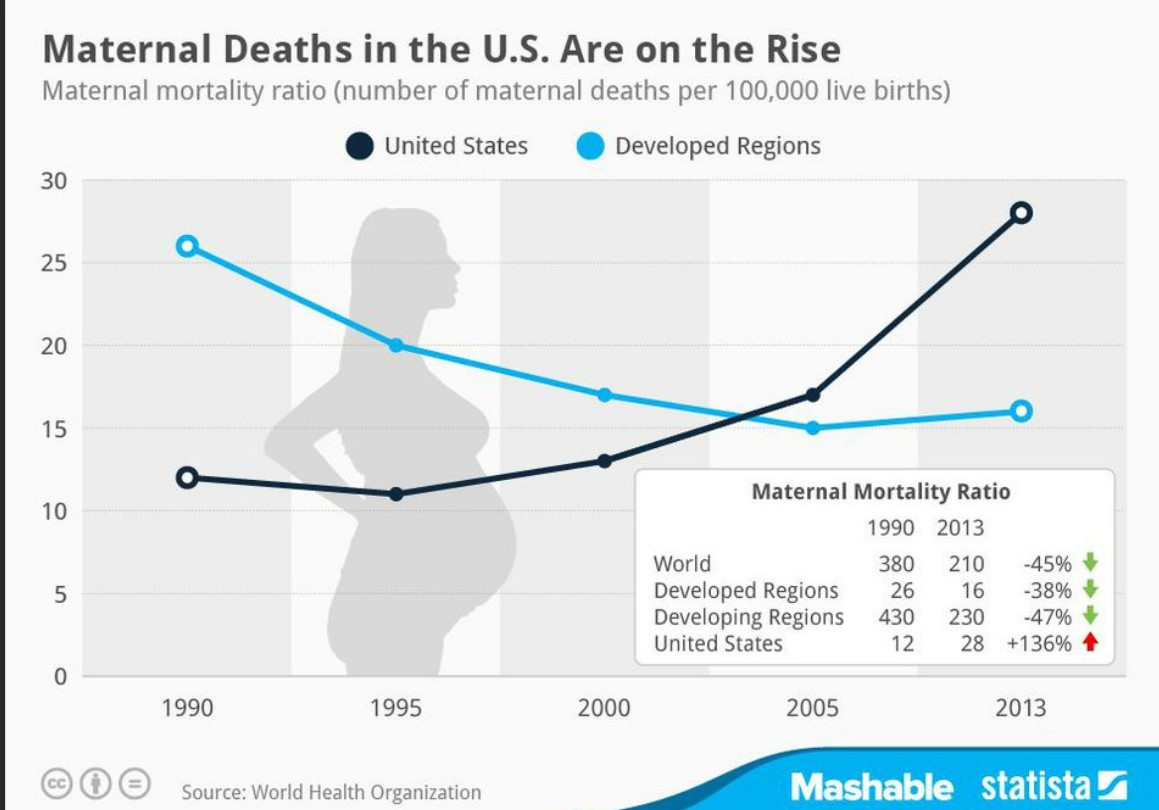
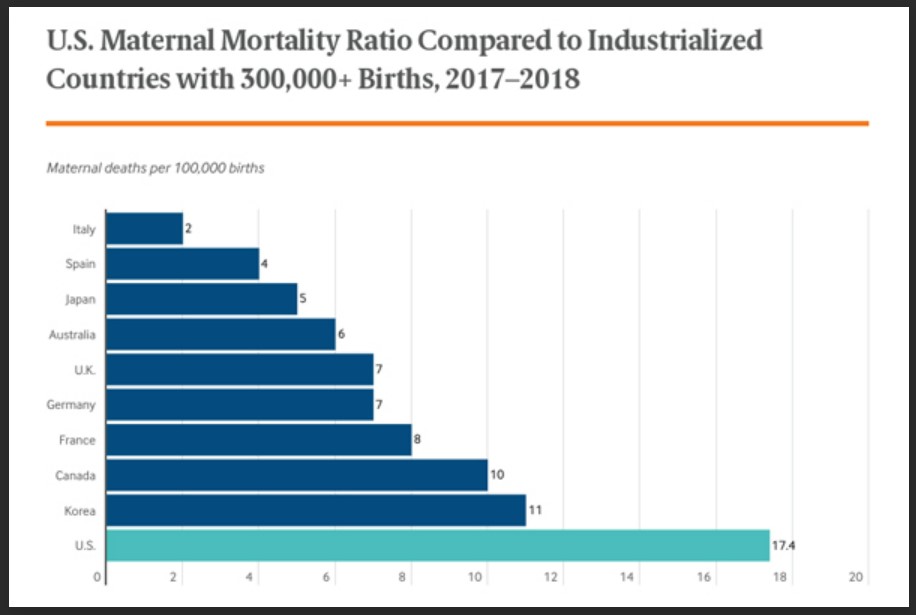
I 100% get it – babies come when they want to come. They don’t break their moms’ water between 9 and 5. They’re born when they’re born. But it’s not just while the moms are in labor has my care been de-prioritized. Many times, while in a gynecologists’ waiting room I’ve been made to wait while a pregnant mom-to-be gets to go first (even when my appointment time was first). In the past 4 years, despite having some serious gynecological issues, my gynecologist has spent maybe the equivalent of 45 minutes of her time with me in an exam room. Our appointments often feel rushed-through and are sometimes for painful procedures that are very stressful to undergo. Even when I have been there and there is an empty waiting room, these appointments seem to have been given less precedence than the pregnant patients’ routine appointments. I got so frustrated last year that I actually googled the phrase “how to find a gynecologist that doesn’t deliver babies and only deals with women’s health issues”. Needless to say, I didn’t have a TON of local results pop up. Many women in my life have had similar issues. IUD placements, birth control consultations, ovarian cysts, fibroids, cervical and ovarian cancer, and endometriosis are all health issues that women that I know have dealt with over the years. And their appointments/care are often on the “back burner” of their doctors’ rotation. You’d think that with all of this over-prioritization of appointments and care for American pregnant women that we’d have the best outcomes in the world. However, per a 2020 CDC report – that’s FAR from the truth.

The United States has one of the highest maternal mortality rates, if not the highest, in the developed world.

https://www.americanactionforum.org/insight/maternal-mortality-in-the-united-states/

Of course, in the report it is even pointed out that there is disparity between white and minority women with minority women dying even more often than white women. As you can imagine the number of deaths increases as the woman’s insurance coverage amount declines. To put it in scary figures, it is safer for women to give birth in EVERY SINGLE OTHER FIRST WORLD COUNTRY on the planet – and most of the third world ones as well with the exception of Sub-Saharan Africa. And it’s getting WORSE not better. So, the “most important job” that American OB/GYN’s are “blowing off” other things for isn’t even going well. With the ridiculous new laws being passed with regulating women’s healthcare/birth control/abortion/miscarriages/forced birth/gender-affirming care can anyone predict anything more optimistic than “more deaths on the horizon”? If you were in medical school right now, would you choose a specialty under such a horrible microscope? Governed in some states by confusing and patient-harming laws? While we have a shortage of doctors now – what will happen when the ones that we do have (despite their range in skill levels) are vastly diminished?
My mom the nurse has always given people the advice to “get a second opinion they’re just doctors they’re not gods despite what their egos may lead you to believe.” I’ve given the same advice to people in my life before, but it wasn’t until my recent health issues that I truly listened and took it myself. After my marriage fell apart due to my husband’s cheating and stealing of massive amounts of money from me, I started having weird and painful abdominal pains. They felt like sharp menstrual cramps but were not near my period and were further up near the base of my ribs on my right side. I went to my general doctor, and she listened, examined me, and set me for a large battery of tests. I had abdominal ultrasounds, transvaginal ultrasounds, x-rays, a CT scan, and blood tests. When they all came back normal, the doctor referred me to a gynecologist to rule out things like endometriosis or fibroids or ovarian cysts (although she admitted that she didn’t see anything like that on my ultrasounds). So, I went to the gynecologist that she referred me to.

In retrospect, I should have stopped seeing this doctor after the first appointment. But I was still so shaken by what was going on in my personal life that I let things slide that I shouldn’t have. I told the doctor I needed testing for STDs since I’d been cheated on and that I had been having a lot of pain. She recommended that I go on birth control pills to control my cramps. I teared up and told her that I had stopped taking them because my husband and I had planned to try for a baby. I wasn’t even divorced yet and felt that taking birth control pills would not only mean that I was admitting to defeat; but was also potentially closing the door forever on what I had so desperately wanted. I told this to the doctor tearfully and her response was “well just so you know if you get pregnant at your age it’s dangerous for you and the baby anyway. I wouldn’t recommend it.” So, we did the exam, she told me to take some Midol if I got cramps, and I went out to the car and sobbed feeling like my concerns were sort of dismissed. The entire appointment minus all the waiting in the waiting room and in the exam-room waiting for the doctor to come in took maybe 20 minutes total, and I walked out feeling like I had no answers. A few days later my test results came back and thankfully I was negative for HIV, gonorrhea, syphilis, meningitis, herpes, and a whole host of other infections. Unfortunately, I tested positive for HPV – most likely due to my husband’s recently discovered serial cheating. The doctor had me come in for a colposcopy procedure to do a biopsy to ensure that the lesions weren’t cancerous or pre-cancerous. The procedure is not fun, and they don’t use any sort of pain medicine. That first test’s results were CIN1 – mild dysplasia that the doctor seemed unconcerned with and told me is a “mild concern” that as long as it doesn’t progress would most likely clear up on its own.

The second year, the process was repeated. She did another colposcopy, and again stated that there was little to worry about as her samples showed CIN1. I asked her if I should get the HPV vaccine as I had seen a commercial that it was now recommended for women up to 45 years of age (When it first came out, I couldn’t get it because I had just turned 22 and it was only given up to the age of 22). She told me that it would be a waste of time as I had already been infected and the vaccine would only prevent new infections. Most of my mysterious abdominal pains had stopped although I was having heavy bleeding and very bad cramps during my period. I told the doctor and again she told me that I should go on birth control pills. I told her that I was simply not comfortable closing that door as I had started dating and had come to terms with “if it’s meant to happen it’s meant to happen”. She again told me to take Midol if I had cramps.

The third year was this year. In February I went for my appointment optimistic that the infection had cleared (the doctor told me repeatedly that most people have cleared the infection by the third year and that as long as there are no changes that I would be in the clear). Again, the pap smear was disappointing, and a third colposcopy was scheduled. (That was the procedure that was discussed above almost being rescheduled due to someone else’s c-section). This time, things had progressed from CIN1 to CIN2 and CIN3. She told me I would need surgery to remove pieces of my cervix to prevent the growth of cancer. Below you can see the Mayo Clinic’s diagram on what the cells on the inside and outside of the cervix look like with CIN1-CIN3 dysplasia compared with cancer.

I called my best friend, who had almost died of cancer at the age of 28 from exactly this same chain of events. She immediately gave me the name of her University of Chicago specialist and told me to call the office that day as her doctor had “saved her life and was the only person who had taken her concerns seriously”. She told me “Forget these podunk suburban baby-deliverers you need a researcher who is a leader in their field not someone who does this stuff just because they have to sometimes.” Unfortunately, her doctor couldn’t take me because he ONLY deals with people who already have cancer. However, his office called me back the SAME DAY, connected me with someone on that doctor’s team, and got me an appointment within 10 days for a second opinion. I had my medical records sent over to the new doctor’s office for him to review prior to the appointment. In the meantime, I researched him. He was an MD and has TWO PhD’s from Yale and countless awards. So, I was hoping that if anyone could give me good advice it would be him.

This man spent 45 minutes with me in his office (in a suit across his desk – not on a stool in some exam room). He gave me an entire science lesson on what was going on in my body. He showed me diagrams, answered all of my questions, and reviewed my case thoroughly. He actually knew my gynecologist and had gone to medical school with her father. He assured me that she was a competent doctor, but he had concerns about my case. He stated that each of the 3-years’ worth of biopsies that she’d taken were far too small to be conclusive or enlightening so that there is a “small chance” that I already have cancer. He concurred with the necessity of the surgery to remove the damaged tissue and find out if there was cancer already and prevent it if there wasn’t. When I told him that I had asked about the HPV vaccine 2-years prior he said “yes you absolutely should get it. It’s been found to boost the immune system in already infected people and help clear the infection. Any gynecologist who has been keeping up on their research should be recommending that since about 2016-2018. I’m surprised and disappointed you were told not to. We’ll get you that shot today before you leave today.” He assured me that my doctor was competent. I specifically said to him, “this is the only life I have. I don’t want competent, I want Gray’s Anatomy Christina Yang-style, confident brilliance. So, are you brilliant?”
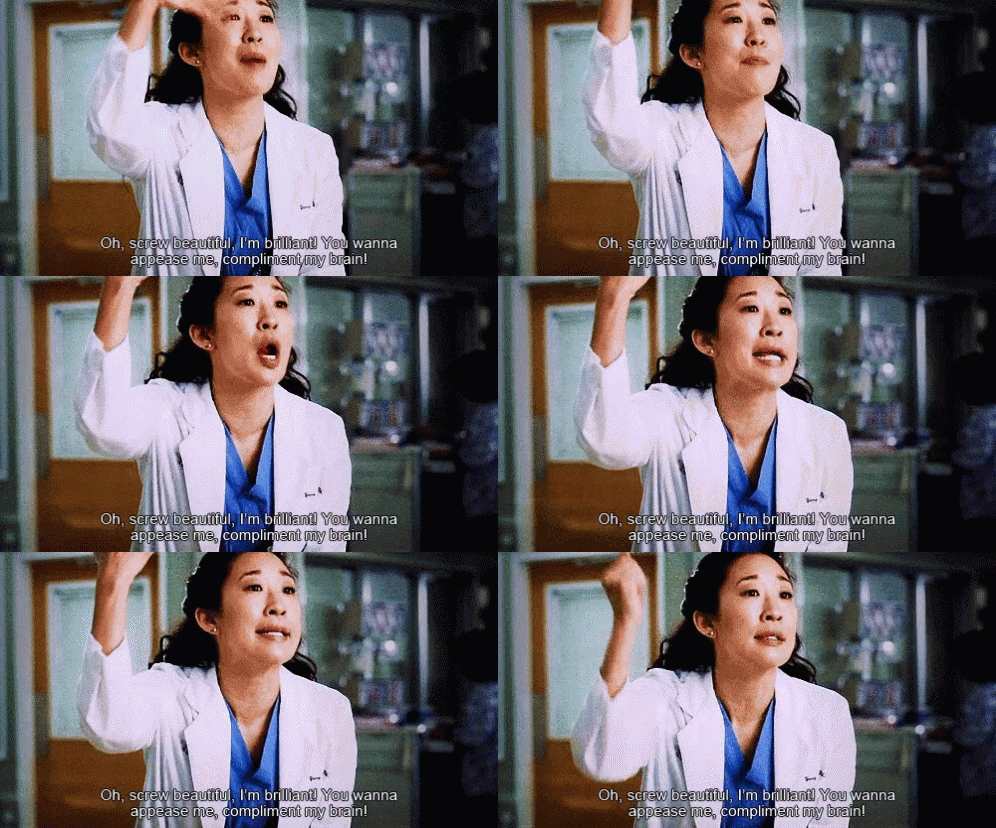
He told me that he didn’t want to toot his own horn and I said, “please toot.” He told me he’d studied at the lab of the man who had invented the Pap smear and had invented a more modern version of doing this surgery that his hand-selected team trains on in practice labs and that he’s done thousands of them successfully. He told me that he’s just a doctor and not a magician and that he can’t help what’s already there but that he does have a plan for the best-case scenario, the medium-case scenario and the worst-case scenario for my care already in place with specialists that he trusts already on hand to assist. He sent me home with diagrams, information, and confidence. I didn’t leave his office wondering if he cared about me. And it wasn’t his “bedside manner” that converted me to switching to his office. He was very clinical. He wasn’t unkind or cold, just very business-like. His personality was actually a bit colder than the other doctor. But he was thorough and exuded scientific knowledge. And his office has a TEAM of specialists who deal with ONLY this issue. His office has both early and afternoon appointments and an entire day of the week dedicated to only surgeries and procedures. I left scared of the future but confident that I would get the best care that his office and team had to give.
So, when I had my surgery yesterday and he walked (more like swaggered) into the room beforehand he calmly explained the whole process to me. He assured me that if there was bad news, he would call me immediately, but he still believes that the chance is small, despite my previous doctor’s (in his words) “lack of attention to detail”. He gave me his cell phone number in case I didn’t feel well, (Despite it being the 4th of July weekend), or something felt wrong when I got home. He explained all of the aftercare instructions to my boyfriend and personally introduced me to all of the nurses on this team. He is not “in this just to hold new babies” and clearly keeps up with and even contributes to new research. I am grateful to have found him. Every interaction that I had with all of his staff have been caring, professional, and have made me felt like my health was their priority. I only wish that I had switched doctors earlier – but due to my having such a hard time finding doctors without months-long waits, I hadn’t even considered that I deserved better.


So today I sit and recover with my painkillers and heating pad – wondering if I have cancer or not – wondering if my first doctor’s lack of attention to me prevented me from catching this earlier. (No less on the 4th of July one year after the overturning of Roe v. Wade). I also sit worrying not only about myself but what will happen to other women when doctors are so swamped that they aren’t keeping up with the most current research, aren’t spending time with their patients, aren’t able to listen to them, and aren’t able to provide them with the care that they deserve. When to keep the lights on, private-practice doctors cram in as many patients as possible, don’t really listen or craft high-quality care plans, or just plain don’t prioritize women’s health beyond the run-of-the-mill normal pregnancy. I will say this much – we have to do better when caring for women in this country. People who can’t easily take time off of work but want to be healthy deserve the opportunity to do so. New moms, moms-to-be, never-moms, and moms-who-want-to-be all deserve high-quality specialty care not just “competence”. If they don’t get it, who will run stores, banks, schools, and retail shops? You want the world to keep on rolling? Supply chains to stay intact? Students to stay in classrooms? Businesses to run? Then we need healthy women who are able to access high-quality care when they need it without delays, under-prioritization, lack of insurance, or a lack of empathy. Women make up more than half of the population worldwide – it’s time to work smarter not harder and to just plain DO BETTER.

The Long & Lengthy ‘Sound of Silence’

Music is now and has always been a tremendous part of my life. It has flowed through my veins and oozed out of my cells for as long as I can remember. Although I was late to the party of choosing my own music to listen to – I started ballet classes at the age of 3 and danced until I was 16. After a rebellious teenage break, I went back to ballet when I was in college. It wasn’t until college that any of my dance classes had a live piano accompanist; and I remember feeling magic at the barre whether she was playing Chopin or a slowed-down version of Michael Jackson’s Billie Jean. There are musicians, dancers, and music fans alike who love music but don’t read music or understand how it works – only how it sounds. And while I’m certain that their love for music isn’t less than mine or anyone else’s – I do feel like when you can read or play music it changes your relationship with and appreciation for music. Much the same way that you can love and be passionate about animals – but having and caring for a pet gives you a deeper understanding of their lives and personalities and gives you an even deeper respect. Music has an incredible power that for the majority of my life brought me happiness in dark times and inspiration and happiness and every other emotion in between.

Aside from classical music, my childhood and early adolescence was steeped in listening to whatever records my parents were listening to. For me that meant a lot of singer/songwriter and folksy music. I watched every Peter, Paul, & Mary live on PBS special; had a deep love of Simon and Garfunkel, and John Denver. (Take Me Home Country Road’ was the recessional hymn at my grandmother’s funeral) As a result, I am a total sucker for an amazing song that tells a story – regardless of genre. (You’re made of STONE if you aren’t moved by ‘Same Old Lang Syne’ by Dan Fogelberg) Additionally, my parents were fans of Broadway musicals, so Pippin, Grease, Camelot, and Jesus Christ Superstar were also in constant rotation. (This is a story for another post but my parents only saw each other 13 times in person before they got married and when my dad visited my mom in NYC they went to Broadway musicals in the 70’s Broadway heyday) That, combined with my dance always made me feel deeply connected with the music on the page, the ability of lyrics to invade your soul and tell a story, as well as the body’s physical movement & choreography to the sound was deeply ingrained in me from a young age. I took piano lessons and clarinet lessons and was in band in both Middle School and High School. I also spent my high school summers being in the orchestra pit of community theatre productions in Highland, Munster, and Crownpoint Indiana. I devoured music in high school like I was starving to death (goth, industrial, punk, classic rock, alternative, heavy metal – anything that I could groove to), and it was the only thing that would nourish me. That’s probably why it surprises people when I tell them that I spent almost 2 full years in total silence repulsed by the thought of music.

In a previous post, I wrote about how I met my ex-husband in 1994 in the Q101 chatroom on AOL. Our first conversation ever was about the Screeching Weasel album Bark Like A Dog and the Type O Negative album Bloody Kisses. He was as obsessed with music as I was. For 20-some years of our long history together, music was weaved through every seam of the fabric of our relationship. While he was a typical high school skateboarding punk rocker, he also had a long and eclectic history with music. He played basically every instrument, had an encyclopedic knowledge of music from classical to current pop, punk, rock, etc. Our connection through music was a cornerstone of our time with one another. Given everything that happened between him and I in the last decade; I don’t want to give him any positive recognition. But the unbiased reality is that he is/was extraordinarily talented. He was a fringe member of the Chicago-based Weasel Family, he played and recorded with John Jughead Pierson and Danny Vapid. So, he was deeply entrenched in the Chicago punk rock community – but it never fully satisfied him. He was so talented that pop-punk was “too easy” for him. He’d play difficult pieces and classical Spanish guitar angrily after coming home from a show because he’d felt “bored” for the past few hours. As a result of this particular trait of his malignant narcissism, he was always starting and leaving bands (usually after burning a bridge in a spectacular fashion) – always searching for musicians that were like-minded and as outrageously talented as he was. By default, since I was the girlfriend/fiancée/wife, I spent thousands of hours in recording studios, at shows, band practices, auditions, etc. When he wanted to write a song or an album, he did it himself.

That whole cycle usually left my ex with the challenge of trying to find live musicians that he considered “good enough” to play with him live. None of these arrangements ever lasted long because he felt that people couldn’t keep up with him. He didn’t NEED to practice so he was constantly frustrated by people who had to – or people that didn’t get a challenging riff or beat immediately. Therefore, I developed deeply entrenched and special memories and remembrances of literally thousands of songs, genres, local musicians, bands, genres, venues, and shows just from spending so many hours around him. To keep myself busy, I graded students’ Constitution Tests in a crappy recording studio in Joliet during a snowstorm and even wrote some Graduate School papers on a laptop at the bar at the Mutiny (RIP Mutiny Chicago). Hopefully the Class of 2003 never finds out that a couple of punk rockers sitting on the backseat bench of a defunct van that was serving as a couch helped me grade their homework before going out on Friday nights. (They were literate and had an answer key so no harm no foul)

After his accident, my now-ex-husband’s betrayals were laid bare to the world, while I was starting a new and highly stressful job and while he was institutionalized in a behavioral hospital. I was driving on a backcounty road between Kankakee, Illinois and my apartment in Schererville, Indiana by myself after a school board meeting one evening in the summer of 2019. The sun was just starting to set, and the weather was gorgeous – I was excited but nervous to be starting my new position even though my personal life was blowing up. I had my sunroof open and decided to turn on some music on Pandora for the hour+ drive home. Every single song on every single station felt like lightning striking my soul. I thought that maybe changing the channel from the Shins and the Yeah Yeah Yeahs to something silly like pop punk would be somehow less emotional. As Teenage Bottlerocket’s “Stupid Song” came on I started to tear up. The last show we’d been to before our wedding with all of our friends was Teenage Bottlerocket at Brauerhouse. I had once driven 7 hours after teaching all day to see him open for Teenage Bottlerocket in Wisconsin and we hung out with the band until 2 am. I spun the digital dial again. There was literally NOTHING I could hear that didn’t tear me to pieces. We loved cheesy 80’s music. We loved watching Bill & Ted’s Excellent Adventure. Shit; God Gave Rock & Roll To You was the recessional hymn at our wedding. I couldn’t even listen to Motley Crue, Kiss, or Poison. Beethoven wasn’t an option; crappy early 90’s hip hop was out too; forget about goth, industrial, or any era of punk rock. Even the stuff that he had never liked and was solely my music was still connected to various events in our shared life and what was going on at the time – positive or not. It didn’t help that my ex had released a whole series of songs that were clearly diss-tracks of me/love songs to his mistress. Although I didn’t listen to it – it was out there in the ether and our mutual friends all had opinions about it that despite their best intentions I didn’t need to/want to hear about. If there is something MORE humiliating than being cheated on by your spouse, threatened by them, having your life savings stolen by them – it is having it all immortalized in music that’s out there in the public realm and completely misrepresents the truth. If anything, it did give me a newfound respect for celebrities who have all sorts of lies put out there about them. I was a nobody and had about 5 people asking me about some songs that very subtly shit-talked me – I can’t imagine living like that with thousands of people in your business all of the time.

Sorry Bob, but respectfully – not always the case.

So, I retreated into a monastic-like existence of absolute silence. I buried myself in work. Thankfully, the school turnaround that I was working at didn’t allow me much spare time or energy to spelunk through the caverns of my sadness. But I didn’t listen to a single song (at least not by choice). I didn’t listen to tunes in the car, or while lying baking in the sun at my apartment’s pool, or while I was taking walks in the forest preserve. I was just living in an eerie silence with a soundtrack of laptop keyboard- clacking. That August, I was grocery shopping, and the radio station was softly playing Flock of Seagulls and I abandoned my full cart and walked right out the door. (Paul Reynolds‘ guitar tone was my ex-husband’s inspiration for his own unique tone) It was as if the whole idea that music was some sort of an emotionally healing balm was just laughing in my face. Arguably mankind’s favorite peacemaker, music, was only bringing more war to my soul.

Wiss Auguste wrote “Once again she was free. Once again, she found peace. It was music that freed her soul from the dungeon of her mind.” But for me, hearing any music at all was putting me in a cage of what felt like hopeless sadness and anger. I felt like I was drowning and choking on any lyric and any melody that invaded my ears just poked all of the sore spots in my brain and my heart. At the time, I didn’t even realize that I was making conscious choices to avoid music. Sometimes when you’re in survival mode your mind and body just do what they have to do to get you through. My spirit was battered, and I could only tolerate a bare minimum of emotion while I healed and rebuilt my life one single day at a time. I am not a religious person. I had always felt a connection to the universe around me and believed that putting positive energy into the world would lead to positivity. For many music fanatics, music is our religion. In retrospect, maybe my silence makes sense. I’ve rarely met a religious person of any creed that has had a crisis of faith who hasn’t struggled with their church. Catholics, Muslims, Jews, or any other religious person can lose “God” and stop going to church for weeks, months, or decades and may or may not find their way back into the fold. So, in some ways, maybe my 2 years of silence was me turning my back on the only spirituality that had ever really mattered to me. A colleague of mine has a podcast where he asks guests, “What have you been listening to this week?” Every time I hear either him or his co-host ask that question, I’m a little relieved that no one had been asking me that question from 2019- early 2021. My answer would’ve been a pretty pathetic and somber, “absolutely nothing at all”.

Between May of 2019 and April of 2020, I was living on autopilot. When I wasn’t feeling stressed and overwhelmed with work and the pandemic and my divorce, I was feeling isolated, sad, lonely, and burned with a constant and simmering anger. I went to work for 12-16 hours a day, I took long walks, I took long naps cuddled up with my cat – but I didn’t listen to any music. I talked on the phone during my work commutes, I watched Netflix shows on my phone during my 3-mile walks at the Forest Preserve, I fast-forwarded through music-heavy portions of TV shows or movies when I watched them. By the time I realized that I was even doing it, I had already been doing it for 6 months or more. Eventually, despite the pandemic I started to think about dating again. Even during the height of the pandemic while submerged in a toxic work environment, things eventually settled into a routine that allowed me to start to decompress a little at a time. Like a teakettle, some of my emotions started to leak out and gradually reduced the pressure inside of me. Without really realizing it, music started to creep back into my life. I still avoided any music that was related to my ex-husband. I didn’t listen to anything that had been played at our wedding or his favorite bands.

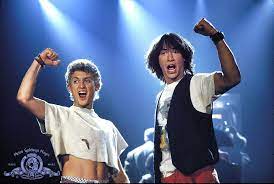
I have always been and always will be a huge Keanu Reeves fan. I have loved Bill & Ted’s Excellent Adventure for decades. As a History teacher, I even showed it to my 6th & 7th graders and had them do a time traveling project at the end of the year when I was still in the classroom. Anytime a sequel or additional movies in a series that I like come out; I usually watch the other movies beforehand to get psyched up. In early August of 2020, I knew that Bill & Ted Face the Music was about to come out. I wasn’t sure if watching the movies and hearing the soundtrack would make me sad or not. I knew that I had progressed a lot in the previous year. I wasn’t just surviving but I was thriving – but I also didn’t want to back slide either. As a result, I watched Bill & Ted’s Excellent Adventure one weekend, Bogus Journey the following weekend, & Face the Music on a third weekend. I figured it would be better to spread out the experience a little and to wait until mid-September to get started on the 3-film process.

As a side note, I went on my first date with my current and amazing boyfriend on September 5, 2020. We wouldn’t officially get together until the following February, but we texted often while we were first getting to know each other during those months. One of the things that he had asked me about (of course) was my divorce, etc. He had asked me how I knew I was ready to date since my divorce wasn’t really that long ago – and I remember telling him that “I gave enough of my life to someone who destroyed me and made me feel awful. I won’t waste one more second on him now that I know who I am and what I want. Life is just too short.” I had no idea if I was over my ex-husband or not – but I knew that I wanted to be and I refused to allow him to prevent me from enjoying (of all things!) Bill & Ted. When I watched Bill & Ted’s Bogus Journey home alone with my cat in my lap – I knew that iconic final scene would be a real test. The outrageous concept that it takes Bill & Ted 40 years of time traveling to figure out how to play a single Kiss song notwithstanding, as I heard the opening chords of God Gave Rock & Roll To You start, I noticed that I was tapping my foot. I wasn’t feeling pain – I was just simply enjoying the moment. I wasn’t thinking about walking down the aisle with my husband at the end of our wedding to it; I was just enjoying Bill & Ted winning the Battle of the Bands. It somehow felt like I was waking up from being hypnotized.

I woke up slowly though. It was another whole year before I found my way fully back to music. When I started my new job at the Middle School where I was once in band myself – at first, I avoided the Band Room when I could. I was no longer fast forwarding through musical parts of TV shows or movies, and I occasionally was listening to the radio while I was in the car – but I was still actively avoiding emotional or personal music connections. When you wake up from a long sleep or heal from deep wounds you move slowly at first. Before you heal, you get medicine or take painkillers so that your pain doesn’t overwhelm your body and you can heal while being numb enough to tolerate life. Over time, burns callous over, and you grow new skin and old wounds don’t hurt anymore. The first step in the process for me was music creeping back into the background of my life unnoticed and serving as” just music”/neutral background noise. Slowly, it started becoming an occasional conscious choice again – and eventually back to what it is now – a joyful and cathartic necessity pulsing through my life – just like the air in my lungs.

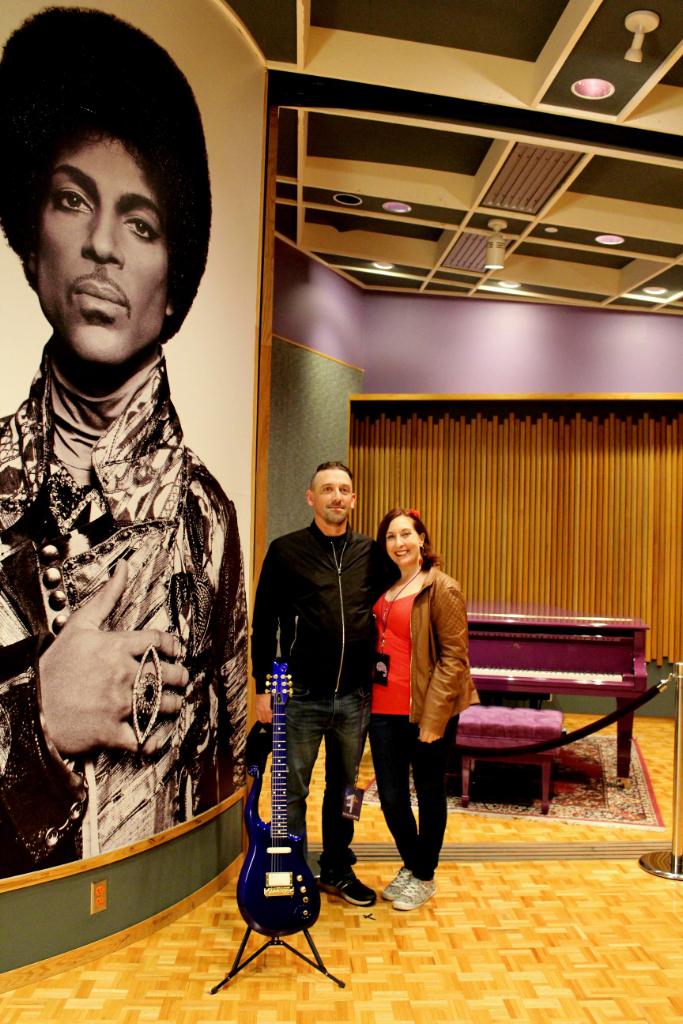
Now, I have a newfound love for and a rejuvenated relationship with music. I have an amazing job that I love and a healthy, joyful relationship with a man that loves and respects me. Not only is he as passionate about music as I am – but we have made new and special memories with a fresh and exciting soundtrack. We have our own awesome and mutual musical experiences together. As a Chicago House Music enthusiast, he’s introduced me to new music that I’d never heard, creating a vibe that is exciting and fresh and fun. We went to DJ Collete’s birthday party at Smart Bar, danced to Tchami at the iconic Club Space in Miami, went on a behind the scenes tour of Paisley Park in Minneapolis and saw Prince’s shoe collection and held his SuperBowl guitar (basking in the eternal presence of one of the greatest musicians to ever live), we do silly dances while making dinner, and we watch old Talking Heads, David Bowie, Ramones, and Queen concerts while cuddled up happily on the couch.

Music is freeing and fun and fresh again. For the most part, even the artists that were the most connected to my relationship with my ex-husband are basically back in my constant rotation. While there are some songs that bring back a sharp twinge of sadness for me and that I don’t choose to listen to voluntarily anymore (Green Day’s ‘Ordinary World‘ that we danced to at our wedding; or Yaz’s ‘Only You‘ that was considered ‘our song’ for most of our relationship; or other songs that we’d had a special connection to) – but I no longer actively avoid them either. My ability to be spiritual and feel connected to the universe has returned. My world is no longer silent and painful – but rather is full of music and emotion again. Instead of draining me, it now energizes me and powers me. Not only do I want to listen to my old favorites, but I want to discover new favorites and feel an energy that I haven’t had in a long time. The next time someone asks me what I’ve been listening to, my answer will be a stark difference from the ‘silence’ of 2020-21. (Unless I’m referring to the song the Sounds of Silence by Simon & Garfunkel which I have been listening to on the first edition Concert in the Park vinyl that my man bought me for my birthday – because I’ve definitely been spinning that lately) In fact, the current playlist will be long and varied and full of options – just like whatever the future may have in store.

When Leadership Was Loneliest

The phrase, “It’s lonely at the top”, is commonly thrown around by anyone in an elite or “top tier” leadership position. Professional athletes, celebrities, church leaders, school administrators, CEO’s, and those who lead organizations worldwide are all familiar with the phrase. While it may seem cliché, the reality is that the higher you climb on any organization’s ladder, the fewer peers that you have, and typically the more responsibility that you shoulder. When I was in my Master’s program for Educational Leadership, every professor that I had (all of them former superintendents and principals), told me that “Leadership is lonely”. They all claimed that to withstand the pressure I should find mentors and peers that I could trust and lean on. They all reminded us that there is only one principal in the building or superintendent in the district and it’s difficult (and very solitary) when you feel like there’s no one to share your struggles or celebrations with. Jane Sigford writes extensively about this concept in her book, Who Said School Administration Would Be Fun? Coping With a New Social and Emotional Reality. In fact, one professor of School Finance advised me and my classmates that the best method to deal with needing someone to trust and lean on as a leader was to “get a dog or a cat. Someone who will love you no matter what decisions you make and who you can endlessly vent to and that you can trust will NEVER tell anyone. Because they can’t talk. I don’t recommend a parrot because that isn’t a 100% guarantee with them.” I often wonder what sort of bird betrayed his trust that he felt that he needed to clarify.

Then, I was still in the classroom and although I understood what he was getting at, I couldn’t truly understand what he meant. I learned his true meaning firsthand a couple of years later as a first-year assistant principal when I was crying all alone in my office at 6 PM on the day. That evening, I had just signed my first recommendation for expulsion paperwork. That was the first moment that I truly felt the weight of his words deep in my bones. You can be an armchair administrator all day long as a teacher. You can second guess and question or even disagree with your principal or assistant principal’s decisions all day long – but you can NEVER feel the weight of them until it’s YOUR signature on the paperwork or your own personal responsibility to make an impossible call. Whether you’re dismissing an employee, handing a child over to Child Protective Services to be removed from their home, recommending expulsion for a 13 year old, or calling a Snow Day – when you know going into a decision that it won’t be respected, liked, or agreed with, and you don’t even know for sure whether or not it’s the right call – you feel an emotional weight that you simply can’t and won’t ever understand as a teacher. Knowing that the trajectory of an employee’s career or a child’s life will be potentially irreversibly impacted by your decision/action is a burden to bear. You have to trust your knowledge, context, gut, and legal counsel and despite everyone’s feedback stick to what you know is right despite praise or criticism. There is a large body of research on the negative implications of suspension from school on students (especially male students and African American students). One study by Lacoe and Steinberg, summarizes all of the negative outcomes on students that have been suspended from school. They state the following:

“We find some evidence that each additional day of suspension for classroom disorder infractions decreases test scores, with estimates ranging from a statistically insignificant −0.01 (based on the fixed effects model) to −0.06 standard deviations in both math and ELA, based on the IV models (Table 4, Panel A). These effects appear to be concentrated among middle-school students (Table 4, Panel C), where each additional day of classroom disorder OSS decreases test scores by 0.07 standard deviations.”

Lacoe, J., & Steinberg, M. P. (2019). Do Suspensions Affect Student Outcomes? Educational Evaluation and Policy Analysis, 41(1), 34–62. https://doi.org/10.3102/0162373718794897

Every time I sign a middle school students’ suspension paperwork I consider how I am impacting their life and what the cost-benefit analysis is for the learner vs. the learning community. It’s not a concept that the teacher has to attach their signature to at the end of the day even if the infraction occurred in their classroom – even if the child was wildly disrespectful to them – or if the kid just really gets on their nerves. It’s not a part of my job that I take lightly. And I have to trust myself when I’m making that call and I have to accept the blow back if my decision is criticized by the parent or teacher; and I have to carry the weight. The classroom teacher doesn’t – at least not in the same way. I know because I was once a classroom teacher who had kids who misbehaved in my classroom. And someone I was glad when they were “finally suspended”. Even though I knew suspension was serious I wasn’t weighing the full cost-benefit analysis to the students’ entire life – I was thinking of the impact on my classroom community.

School leaders’ role in making weighty decisions are a shared professional experience. With that being said; you’d think that leaders could at least rely on one another for support when it’s needed. To a certain extent that’s true. I rely on the moral support that I get from Twitter, LinkedIn, and Facebook leadership groups often. I enjoy the networking, the advice, and the helpful tips that my skilled and respected colleagues have to share. I have always firmly believed that if people pool their resources and share the combined wealth of their knowledge; all can benefit. I turned to those groups heavily during the beginning of the COVID-19 pandemic as a leader in totally uncharted waters. On March 13, 2020 my district’s superintendent and Teacher’s Union President toured all the schools to make the announcement that the following day would likely be our final day of in-person learning. Teachers were told to say goodbye to their students with the understanding that they likely would not see them in person again that year. Everyone was told to bring all of their belongings home and to prepare for remote learning for potentially the rest of the school year. Once the governor declared the State of Emergency the following day, it was determined that no one was to report to the school buildings in person (including administrators).

In my district, all work by all employees was remote until July 1, 2020. Beginning on July 1, administrators, lunchroom staff, and 2 secretaries per building were mandated to return to the schools in person. While there, their responsibilities were to oversee food distribution to needy families and to supervise remote summer school classes while planning for the start of the next (remote) school year. All of us were working grueling hours (albeit it from home from March-July). Vacation days were cancelled or weren’t approved. No one had any rest. The kinds of stressful decisions being made about how we would organize any sort of remote/hybrid learning for the fall; how to staff our buildings; and the myriad of other decisions that needed to be made kept us on zoom from 7am-at least 6:30PM 5-6 days a week. I still have a screen shot of a meeting that I was in that lasted well past 9 PM on a Thursday evening. Saying that it was hard on all of us is a gross understatement. All 3 of these pictures were taken on the same day (From left to right 11 am, 4 PM, 8:45 PM)

To put my own experience in perspective, I was living alone (with my 2 kitties); going through a divorce from a man who had cheated on me and stolen upwards of $100,000 from me, and was in a highly toxic, defeating, and punitive work environment. I had just started considering dating again when the whole world shut down and there was simply no where to go, and meeting people seemed even more risky and dangerous than before the pandemic. I was socially isolated from friends, family, and coworkers. I was certainly feeling overwhelmed and stressed from work – but I was also experiencing a very deep loneliness that was beyond the typical “leadership loneliness” that any school administrator eventually grows accustomed to. So like many of my peers, I turned to my digital support system.

I suppose I didn’t know what sort of solace I was hoping to find in my networking groups. But instead of comfort, I actually felt stark alienation from the very group of people that I had come to trust and rely on when I was feeling professionally burdened. I was serving as a high school assistant principal (in a building without a principal or even an interim principal), during a global pandemic. It was definitely not a welcoming or a healthy workplace before the pandemic – but COVID exponentially exacerbated the negativity and toxicity. As I scrolled through Facebook and Twitter groups of school administrators (all just as stressed and overwhelmed and emotional as I was), I actually began to feel a whole new level of anxiety and even jealousy.

While I can certainly IMAGINE that being in the house 24/7 with children and pets and working from home was probably stressful for a lot of families – it broke my heart to read complaint after complaint about “I can’t take being in the house with these kids/my husband/these dogs”. Even in my fellow school administrator groups, it seemed like everyone had nothing but negative things to say about being “stuck” with their loved ones 24/7. For those of us who were ALSO leading a school through an impossibly stressful time, but were ALSO doing it totally ALONE with no one (in person) to support us – it almost felt like a slap in the face. I felt angry and isolated. How dare these people that were so blessed to have children or a spouse (something I had been robbed of and wouldn’t get to have) be complaining about the sound of happy laughter coming from their basement? Didn’t they know that some of us would have KILLED for their “problems”? If only I could have had someone right there to hug me after an awful and frustrating work call that lasted until 9PM! While it is always easy to fall into the “grass is always greener” trap of comparing one’s life to other people’s – it was especially hard for me to keep those feelings in check in late 2020.

When I got my signed divorce papers in the mail I didn’t know what they were. It was just a plain envelope from my lawyer’s office. Since my ex-husband had been institutionalized, hadn’t hired a lawyer, and had hid from me and the entire process – I hadn’t received any updates on the ongoing progress of my case in months. Honestly, I remember running to the mailbox when I heard the mail carrier (because some days he was my only human interaction and I’d gotten into the habit of waving at him and saying hi from behind the glass). I recall grabbing the envelope out of the mailbox and expecting it to include a bill for some additional hours related to the marshals that were needed to locate my ex-husband when he hid and failed to appear in court the previous November. There are just some memories that you just FEEL deep inside of your bones even years later. (Where you were when the moon landing or 9/11 happened, where you were when your parent passed away, the smell of your house on Christmas morning, etc.) For me, opening that envelope on April 8, 2020 is one of those moments forever both frozen in time and viscerally reexperienced as a full body memory anytime it’s mentioned. I was standing in the front hallway of my house and tearing open the envelope while the smell of brewing coffee wafted in from the kitchen. The house was silent other than the Keurig bubbling in the next room. A single-spaced letter on my lawyer’s letterhead simply stated:

“Dear Jennifer, Enclosed please find a copy of your Decree of Dissolution and Property Settlement Agreement which was signed by the Judge. As of the 6th day of April 2020, you were officially returned to the status of a single person. If you have any questions please contact my office at your convenience.”

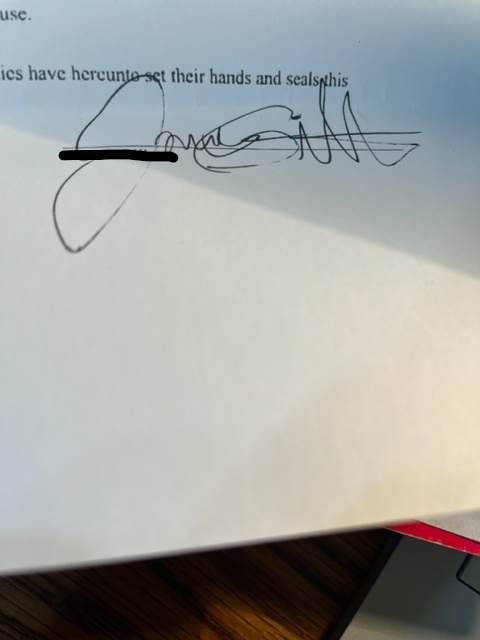
And that was it. It took me less than 5 seconds to read. I dropped to the floor like a bag of cement (my right knee cracked) and sat down like a kindergartener with my legs crossed right there in my front hallway. My hands shook and I turned to the back page. I don’t know what I was expecting to see there. For more than 20 years I had seen my husband’s name signed on a variety of documents. His gorgeous penmanship had always impressed me. He was left handed but ambidextrous. His perfect Palmer method cursive was always gorgeous and identical regardless of which hand he had used. When I saw his signature on our divorce decree I choked and cried uncontrollable tears of rage and sadness. I had never before and have never since felt more lonely in my entire life (including the period after my college house fire I mentioned in a previous post). His signature was sloppy and careless and not his usual gorgeous handwriting. He hadn’t even cared about me or what he’d done to me in the past several months to take the time to write his name properly for the court. I had had no warning that these papers were coming. I was alone at home during the height of the uncertainty of the pandemic. And every school leader that I had come to rely on for support in my loneliest moment – was griping and complaining about being home with their loved ones while I cried in an empty house. As a leader and as a human being – I had never felt so alone and insignificant in the universe.

I thought that certainly there were others like me out there but maybe they had also been quiet in the digital world. In a school leadership Facebook group that I had long been a member of – I took a big vulnerable risk and made a long post. I basically asked the question: “Is there anyone else out there doing this right now – ALL of this – but is also doing it completely alone? Is there anyone else out there conflicted and angry by seeing people with spouses & families – that are blessed to have them – and feeling isolated and pissed off when they see all these people complaining? Is there anyone out there AT ALL who is seeing the “get out of my home office kids!” with the adorable pictures of kids on their parents’ laps and is feeling incredibly jealous?” “Is there anyone else out there pissed off and TOTALLY alone?” And initially, I was overwhelmingly “supported”. People patted me on the back for running a school without a principal or district support; people praised me for being brave and facing a divorce alone; several people that also lived alone offered some encouraging words. However, much of the support offered also felt like backhanded compliments or even “leadership critiques”. Several people offered me support “but you should cut people slack for complaining about how difficult it is to work from home with kids”, or “you’re doing a great job and I’m sure it’s hard but have you considered counseling” (I was seeing a crisis counselor already). Or my personal favorite, “It must be hard to see all those posts but don’t forget that this is hard for everyone – even those who have 3 kids, 2 dogs, a cat, and a husband to keep them company!” All I was seeking was maybe a little bit of empathy and I was pleading with my support system to maybe consider how great they just may have it. A simple request to maybe consider the diversity of their audience before posting complaints, especially when some of that audience didn’t have the added “burden” (or as I viewed it – a blessing) of GETTING to do any of this with the ones they loved. Maybe it was simple jealousy. And maybe it was because I had turned to school leaders for support.

Leaders LOVE to offer advice. They get paid to solve complex problems and mentor people. They ask you if you’ve “considered all of the stakeholders viewpoints”, or if you “asked the right people for feedback.” And in a Building Leadership Team meeting or a parent conference, or any other WIDE variety of scenarios that would 100% be the correct response (and welcomed by any good leader). But in reality, all I had wanted was a “wow I didn’t realize there may be people out there feeling this way. I validate your feelings. I feel really blessed to tuck my kids in at night. I’m here for you if you want to talk or scream or yell or throw things.” Sometimes all people need is an ear to listen without being offered a toolkit for addressing their feelings. In the years since, I have consciously tried to become the empathetic listener that I had needed to break my loneliness on April 8, 2020. I have made a concerted effort when colleagues or friends have started venting about something to ask the question, “before we go on, do you just want me to listen, or would you like advice, or a combination of both?’ Or I say nothing at all and let them finish and then say “How would you like me to support you?” One person from that Facebook direct messaged me with the very simple message, “I can’t believe how hard what you’re going though must be without anyone else in your home to share it with. How can I support you?” Honestly their message just made me feel seen and heard. We had a good conversation about what loneliness really is and compared ways that we’d each dealt with it in the past. It felt 1000% times better than any of the “pity” or the “backhanded advice” I had received from anyone else. I left that group because eventually it got exhausting to reexplain my feelings or my situation to so many different people as new people came across the post and would comment. Sometimes you have to stitch the wound and let it heal and not keep tearing it open.

My experience is sort of an example of what happened to the personal and professional worlds during the height of the pandemic. Everything felt squished together in a way that it hadn’t been previously. When people left work, they left work and family time was family time. Home was home and work was work. (One can argue that the last 10 years’ worth of technology had already been blurring these lines – and one would be correct – but COVID and remote work cemented the deal.) I think that if I had been a member of a parents’ Facebook group the expectation of people discussing their family issues would’ve been more predictable – but I was in a group about leading schools. As school leaders were working from home and the lines became more and more blurred, it makes sense that the venue had a lot of cross over. Upon reflection, I can’t blame my peers for looking for solace the same way that I had been. It isn’t that surprising that their personal worlds were colliding with their professional ones and creating a whole different and new category of frustrations. We were in the same storm but we all had different boats. In the middle of a hurricane, whether in a cruise ship, a yacht, a pontoon, or a dingy – the storm is scary and it sucks. The stress on school leaders has increased to the point of crisis levels. Per an article in Education Weekly, “The Center for Creative Leadership found that, “Eighty-eight percent of leaders report that work is a primary source of stress in their lives and that having a leadership role increases the level of stress. More than 60 percent of surveyed leaders cite their organizations as failing to provide them with the tools they need to manage stress.”” We were all paddling wildly in that storm from our respective boats – but some of them were more seaworthy than others.

It is NEVER a popular move for a person with no children to tell people with children not to complain. (So stop reading now if you’re about to get offended) But nonetheless it is VERY difficult when you’re completely isolated, mourning the children you’ll never have from a marriage that unceremoniously ended after a couple of months, while also leading a school alone through uncharted waters, to empathize with someone “complaining” about getting to spend time with their adorable toddler who woke them up at 5 am. Maybe it was just petty envy, but it was a hard pill for me to swallow at the time. Even years before my marriage blew up, it always sort of irked me on Daylight Savings time when I had friends and colleagues complaining about their kids or pets “getting them up an hour early because of the time-change.”

For example, I have a high-school acquaintance who struggled with fertility. She had her sons at 38 and 40 after years of heartache and disappointment. Prior to her sons being born, all she could talk about was how badly she wanted children. Then she had them. And ever since then (but especially during the pandemic), she has frequently complained about how “mom tired” she is, how early her kids get her up on the weekends (she’s always loved to sleep until early afternoon), and is a prime “daylight saving time” griper. In April of 2020 when it came across my timeline (fresh off that crushing divorce paper delivery), I simply commented “maybe you should phrase your fatigue as a scenario where you GET an EXTRA hour with the children you so desperately wanted, while those of us without them to hug right now might be feeling an extra hour of absence or even envy or loneliness.” (Let that hypocrisy flag fly there as I did exactly what I was complaining that my colleagues had done to me when they asked me to consider my stakeholders lol) I am normally a champion of being grateful. Most of my life I have been grateful for everything that I have and have always tried to squash any tempting “the grass is greener” feelings. Most of the time I am a happy, content, peaceful, and relatively zen person. But April of 2020 wasn’t one of my finer moments. Whether it is fair or not, I do somewhat still internally judge parents who are always complaining about their kids. I 100% identify that I can’t relate to their personal family dynamics and the challenges their children pose. But I’ve learned how to accept my own personal reality and celebrate what I have rather than mourn what I don’t since then. I do however, feel like 100% of all people can empathize with loneliness.

In the time since April of 2020 my life has been completely transformed. I have a great job in a place that is supportive and healthy and non-toxic. I have a great and happy and functional relationship. I have a supportive and high quality (albeit it small and tight) social circle. My work-life balance is decent (although during teacher evaluation season it is less awesome). I don’t look back on that time with regret or anger or sadness. Instead, I prefer to think about the insight I gained on listening and empathy that I now have as a result of that period of my life. While I didn’t know it at the time, my being vulnerable, reaching out, and not quite getting what I needed was a great training exercise for me to become a better listener and communicator. It will always be like poking a scab for me to remember the way that I felt opening that envelope in my hallway all alone. But it’s a nice point of comparison when I think about where I am in my life right now and all of the wonderful colleagues, friends, and loved ones that I choose to surround myself with now. By learning what I needed in and from a support system – I feel like I was able to (painfully) grow and become a more supportive person myself. I would like to believe that being an empathetic listener who isn’t “leading” or “advising” all of the time makes me a better partner, friend, and leader for others.

Cult of Negativity

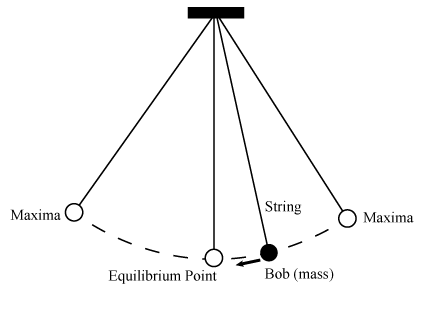
The age of COVID-19 has (yet again) pushed teachers/schools/administrators/school districts into the limelight in a very familiar way. From March-June of 2020 all the “OMG teachers are HEROS! DOUBLE THEIR PAY!!” hysteria took flight all over the internet. For a hilarious take on this check out Key & Peele’s TeacherCenter Videos. As an educator of 20+ years, I viewed the positive press with dubious optimism. In school administration, my colleagues and I often speak about the “pendulum.” The pendulum always seems to swing too far in one direction and then a few weeks, months, presidents, etc. later – it snaps back in the other direction jarring educators and shocking the system until (like all pendulums) it settles into an equilibrium point. Here is a list of just a few examples of the pendulum “swinging too far”:

  • Standardized testing. (From “hey let’s do this a couple of times in your academic career so you can compete to get into college if you want to – to “we’re falling behind the rest of the world OMG let’s test 8 times a year, judge teachers and schools on their scores and punish those that don’t perform, to hmm we’re worried kids are tested too much and a lot of colleges aren’t even requiring these tests anymore but we’ve gotta judge the teachers and schools somehow so let’s keep it up – yes even during COVID)
  • School safety/discipline. (From open-door policies, zero-tolerance and metal detectors, to ‘metal detectors make schools feel like prison, to Restorative Practices, to no zero-tolerance, and now onto “post-covid behaviors are out of control let’s go back to super punative again”)
  • Etc., etc., etc……
A simple pendulum – mentally insert any educational policy ever invented onto the illustration.

The list goes on and on. But in general most school leaders that I know watched all of those “Teachers are Heroes” reports on the news in 2020 with trepidation – all of of us knew that it wouldn’t be long before we’d all be villainized again. I firmly believe that if COVID-19 had just suddenly disappeared in June of 2020 and we returned to school as “normal” in the fall of 2020 with the pandemic just a distant memory, the pendulum wouldn’t be swinging so wildly now. Maybe schools would even have gained a ton of respect and gratitude and would have gained legions of parental involevment and support by grateful parents fresh out of pandemic learning. But as any teacher or administrator who is currently trudging through what most of us consider to be BY FAR the hardest year that we’ve ever had, will tell you – instead it’s been a rollercoaster. To see the same parents who were screaming for us to get raises in March of 2020 now screaming at us and complaining about every decision made since returning to school in August of 2021 – just stings. Actual assaults of school board members, principals, and teachers over mask mandates, elearning options, and hybrid schedules (that were all implemented with the express goal of protecting children) are a far cry from the “PAY THEM DOUBLE THEY’RE SAINTS!” rhetoric of April 2020. Feeling that pendulum swinging has definitely been a demoralizing and often frustrating experience for all teachers and administrators. In truth, I don’t know a single educator who isn’t experiencing an unheard of level of stress, depression, anxiety, burn out, or PTSD in some form or fashion brought on by the pandemic.

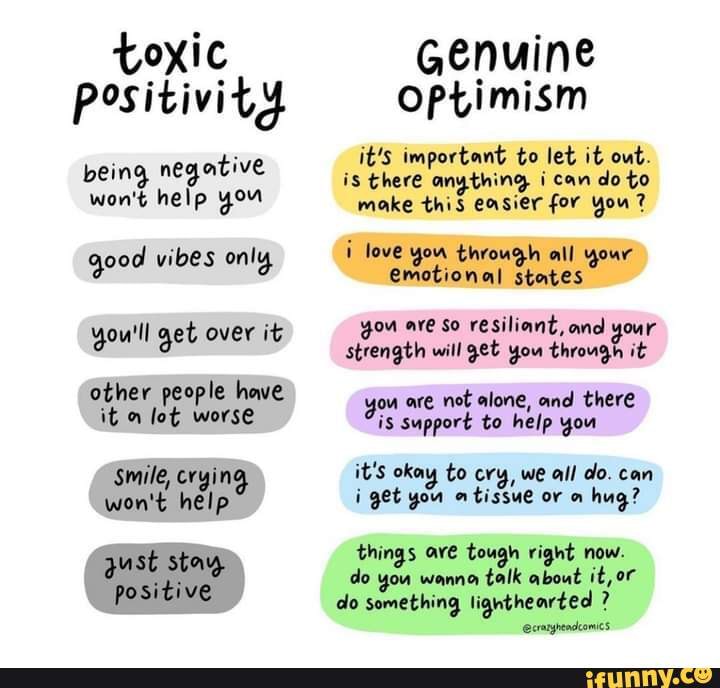
During the pandemic, the concept of “toxic positivity” and it’s impact on teachers began to get a lot of attention. Examples of “toxic positivity” in schools include the overuse of the sentiment, “it’s not about us it’s about the kids,” or administration holding a “wellness day” where staff are required to participate in “self care” activities for a day but the very next day the real issues causing burn out aren’t addressed.

Toxic Positivity Vs. Optimism

And toxic positivity in schools IS certainly an issue. There’s NO denying it – but there’s also an insidious force working inside of many schools, within groups of educators in person and on social media that I refer to as the Cult of Negativity. And the most discouraging part is that many that are deeply involved in the Cult of Negativity are some of our very best teachers – who don’t even realize that they may be contributing to it. The trials and tribulations brought on by the pandemic have made this Cult of Negativity so much more prevalent and active – especially virtually.

Some people do just want to be like Skeletor!

When you move from the classroom to an administrative position in schools – a lot of your teacher friends accuse you of “turning to the Dark Side”. To be clear, being a teacher is VERY difficult. It is hard and very demanding work (both academically and emotionally). The work is stressful, and it is often incredibly thankless. But when I look back on the very worst of my teaching days – they were still a lot less overwhelming or demanding than my days as an administrator. If you take all of the difficulty, demands, stress, and the thanklessness of teaching and multiply it by about 100 times you get to the level of stress on deans and assistant principals; now if you multiply THAT amount by 100 and you get the principal’s level of stress. Then of course you multiply that some more and get to the Central Office amount of pressure. Often school leaders don’t/can’t talk about this pressure and intensity because part of our role is to support our staff – we aren’t allowed to “break” or to show weakness because it “lowers morale”. Also – if you do try to be vulnerable with your staff or teachers, the frequent (and insulting) response is the dreaded comment, “that’s why you get paid the big bucks!” So we close our office doors on tough days, scream into a pillow, eat the chocolate hidden in our bottom drawer, and slap a smile on our face and visit some classrooms. We confide in our closest colleagues and our pets because there are a lot fewer leaders than there are teachers. Our circle is much smaller and there are a lot fewer people who know what it really feels like to do the job. One of the toughest parts of the COVID-19 pandemic was the constant barrage of “support the teachers, support the students, support the parents, etc.” and there was often no one for us to go to for support. A lot of the pushback against “toxic positivity” was coming from teachers and directed at administration. As a building administrator, a lot of this criticism was directed at my team because we were the ones delivering the messages – although many of those messages were coming from Health Departments, Governors, or State Boards – nor ourselves.

One example of this occurred at one of my previous schools. Building administrators were directed to improve morale and make sure our teachers felt appreciated. Since anything that my team did for our staff of over 120 teachers basically had to come out of our own pockets – we couldn’t really spend $1000’s. So we made them a cute make-your-own caramel apple bar and told them to help themselves to some “apples for the teacher”. My team and I went classroom to classroom to relieve teachers to ensure they each got a break to make and eat their snack and socialize.

Like Mother Teresa says – the joy of giving is pure joy. But being told “Thank You” is also priceless.

The teachers (many of whom we had very positive relationships with), knew we had spent our own money and that we meant well – but they didn’t want caramel apples – they wanted extra planning time. So when I saw their hurtful Facebook posts about “Thanks for the apples but I still had to do x, y, and z”; admittedly, it stung. What they WANTED were things that were outside of our locus of control to give them. Only the district or school board or governor could give them that. So my team and I were stuck in the middle. We had been DIRECTED to do something nice for our teachers – while what the teachers WANTED wasn’t something that we were able to give them. The teachers knew how hard we had advocated for them behind closed doors and begged for things that we just couldn’t get for them. But the building leaders took the hit/blame regardless. Meanwhile, when teacher morale is low – district leaders look to building leaders for answers/blame. Despite being a big part of the job, that’s tough on building leaders’ morale. We had spent our own money to bring a little cheer into our staff’s morning – we had done what we COULD to show our support. But of a staff of 120 – a total of TWO people thanked us. (Not that we were looking for thanks). But at least 40 complained or went out of their way to mock our gesture. On top of that, upper administration also fired back with “why is your building’s morale still so low? You were told to address it.” As a building leader you are often stuck in between these two opposing forces and you take the negativity from above, below, and outside simultaneously. It begs the question: who is taking care of the building leaders? And who will lead when and if they all give up and leave?

Concern for school-level leaders’ morale is not necessarily a new problem. PRIOR to the pandemic 1 in 5 school principals was already considering leaving their position due to stress. Now, the numbers are much higher. Peter Dewitt addresses this in his Education Weekly Article from 2020. Since then, the numbers have become even more bleak.

“A recent poll by the National Association of Secondary School Principals (NASSP) and Learning Policy Institute (LPI) revealed that “42% of principals across the country said the pandemic has accelerated their plans to leave the profession.” That’s too many of our school leaders feeling as if there is nowhere to turn but away!”

https://www.edweek.org/leadership/opinion-principals-assessment-were-not-ok/2022/01

While I personally am quite happy in my current role, I know that out of all the stressors that I face on a daily basis – almost none of them are actually the children. My top 5 stressors tend to change in priority from day to day – but almost always parents and teachers are near the top of the list. To be clear, I LOVE to support teachers. I consider it one of my professional strengths to coach teachers and assist them in truly improving their instruction and making positive changes to improve their relationships with students and parents, helping them to create thriving learning communities, and addressing the learning needs of their students in proactive and effective ways. I have a good coaching relationship with almost all of the teachers that I work with. We have friendly, productive, and collegial relationships. I DEFINITELY do NOT work in a toxic environment (although I certainly have worked in toxic places in the past). Despite all of that, I definitely work with some people who engage in what I call the “Cult of Negativity” (many without even realizing that they are doing it).

I have to admit, that when I was a Social Studies Teacher at a 6th-12th grade campus there was a period of at least 2 years when I was an active member of the Cult of Negativity. I had NO idea that I was being negative or toxic at the time. In my classroom then, I was very much at the top of my game instructionally. I was experienced, I was positively impacting my students’ test scores, and I had great relationships with most of my students and their families. I participated in a wide variety of school and District Curriculum Committees, and considered myself a teacher-leader at my school. But on the flip side, my campus was instituting an iniative called “meticulous lesson planning.” (I can literally FEEL teacher-readers groaning at the name alone). Our overall schoolwide achievement data was suffering. Our average ACT score was maybe a 17. Our School Improvement Goal was to get it up to at least a 20. A professional consultant was hired to observe the school all day everyday for a month and then make recommendations based on the instructional trends that they saw. One of the items that was considered “low hanging fruit” (easy and fast to implement without a lot of training) was a cycle of meticulous lesson planning, using a research-proven template that forced teachers to address a certain continuum of student skills on a weekly basis.

Submitting lesson plans is ALWAYS a hot-button issue for teachers. Great teachers get offended because “it’s a waste of time, I already think about and do all of these things why are you making me write it down? If you want to know what’s going on in my classroom just come in and watch.” There are entire blogs, Facebook groups, and Instagram pages created by great teachers trashing the idea of submitting lesson plans. Even teachers that are struggling/aren’t as strong hate doing it because they’re already drowning just trying to keep their heads above water and would prefer to spend their time on other things. Oftentimes administrators also hate it because there aren’t enough hours in the day to observe all the classrooms and read all the lesson plans AND handle student discipline, etc. And frequently, lesson plans do result in difficult conversations between administrators and teachers (even their best teachers) due to plans not being submitted on time.

I HATED the meticulous lesson planning school improvement process. I resented having to write and turn in approximately 12-page voluminous lesson plans daily to my Department Chair. And I’m sure my Department Chair didn’t exactly love burning the midnight oil giving all of his teachers written feedback on their plans either. In retrospect, our administration definitely could’ve presented it to us so the process was more well-received and so that teachers bought into the process. (Maybe we could’ve alternated every-other-day or every-other-week to lighten the load and make it more manageable for everyone. Maybe some other initiatve could’ve been taken off of our plates in order to make it manageable.) But regardless of what wasn’t done to make the medicine go down easier, we were going to submit our meticulous lesson plan templates every day and our Department Chairs would give us feedback. I’ll be the first to admit – I’m a rule-follower. I comply. I did my lesson plans. And I HATED every second of it. I bitched and bitched a blue streak to my colleagues in the teachers’ lounge, I rolled my eyes about it in meetings and completed what I openly called an “exercise in compliance”. But I was never insubordinate. I never was outwardly disrespectful to my supervisors or administrators. But when I reflect on it now, my complaints to my colleagues about it were contributing to the Cult of Negativity.

In retrospect, even though I LOATHED every second of those meticulous plans – I have to admit they DID make me a better teacher. They forced me to preemptively put on paper possible student misconceptions. They forced me to pre-plan what questions I would ask to which students in which class periods. At the time I THOUGHT that I was mentally doing all of these things a LOT more often than I truly had been. I actually learned through doing the painful process that I called on girls twice as often as boys (despite having twice as many male students). I discovered that I was assigning more homework than I really needed to, and that I wasn’t giving students as much input into the curriculum as I thought that I was. This process pushed and challenged me in a way that I never would have done on my own without doing meticulous lesson planning. Why would I have? I thought that I was an experienced profressional who “knew what she was doing, and deserved the trust and respect of administration.” But is being “good enough” a reason not to get better? As a result of participating in what I considered a “stupid exercise in compliance”, at the end of the year my students’ test scores grew MUCH more than they had in previous years (despite the fact that I was already considered a “strong teacher” by my administrator and myself ). If I had never gone through that painful growth process, my students would’ve still learned because I was proficient – but the lesson planning process REQUIRED me to be more intentional than I had ever been. It FORCED me to attack certain parts of my planning that diagnosed issues and student needs in a much more fine-toothed manner that I had been doing previously. Once I worked at a building where lesson plan submission wasn’t required at ALL – I was still mentally going through a lot of the steps that that hated template had taught me and was doing it naturally. But I had no idea if my colleagues were being intentional or not because they weren’t even required to write anything down ever. To a certain extend the old adage is true – you can only expect what you inspect. You can’t inspect what’s not even visible.

Kindergarten Cop – always an inspiration!

Now if I had been a poor teacher to start with – this process would’ve still made me become an intentional planner – more well-prepared for the types of things that can go off the rails during a lesson and handle it in a poised manner. If I was a really bad teacher – it might’ve pushed me to become at least OK enough to make sure students didn’t backslide – to ensure that I wasn’t HARMING the kids that I was in front of everyday. The reality is that we should grow teachers and make sure they continue to improve (even the experienced ones who “know what they’re doing” aren’t perfect and can always be better). But the reality ALSO is that students only get ONE chance at First, Eighth, Eleventh, or any grade. And as school leaders – it is our RESPONSIBILITY to “do no harm”; and guarantee that teacher quality ensures that each student grows at least one year’s worth of knowledge/skill level/grade level each year that they are in front of us. And that if their teacher isn’t that intuitively strong or is struggling – it’s a leader’s job to ensure that they are ADEQUADE ENOUGH to ensure that a child’s education is still positively impacted. If you went into a hospital for a surgery to have a basic operation to remove your tonsils in a routine operation and were operated on by the intern that had already botched 3 or 4 previous surgeries – I would HOPE that their supervisor had gone through their surgical plan with them in detail before allowing them to pick up that scalpel and operate again. If something went wrong not only would the intern but ALSO their supervisors be committing malpractice. Our students are BEING OPERATED ON and are trusting our capable hands. If we have hands that we aren’t sure about in the operating room or hands that sometimes shake when they get nervous – we have to constantly supervise them, insepct their work, and make sure that those hands either become capable enough to do routine operations effectively and safely – or we need to find them a job at the hospital (or somewhere else) that is better suited to their skill set. At the end of that year of meticulous lesson planning – AS A SCHOOL – we didn’t have ANY teachers who were weak enough to have to be dismissed. Our test scores went up, school culture improved, and we met our School Improvement Goals. I’m still very proud of the progress we made as a building that year. Sadly, I’m a lot LESS proud of my own behavior that year.

At one point, my Department Chair met with me in private and told me something along the lines of, “You’re a REALLY great teacher. And even though you HATE doing it – this process is making you even better. But you acting like you don’t need this process because you’re already a good teacher, or that you hate it – that sabotages the idea that as a SCHOOL we need this. Here’s the problem with good teachers – you don’t understand that not all of your colleagues are doing what you are – that they NEED to LEARN how to teach or to improve their methods. They need to go from good to great; and great to awesome. Some of them AREN’T that “naturally” good and just need to get to adequate so they can get to good and then to great. And everyone can push themselves. Even Stallone has some weak muscles and has some exercises he HATES to do but needs to do to really be his best right? Don’t be a disgruntling factor. Part of improving as a group is being positive about things that maybe we don’t want to do. Disagree in private. Make your concerns known at the leadership meetings. But cheerlead in public.” At the time, I misunderstood his point – I felt chastised. I thought he was trying to tell me not to share my concerns or ask questions. In reality, he was trying to encourage me to use my powers for good and to help be a positive leader. Now, I’m grateful he had the conversation with me. I still FULLY encourage teachers to ask questions or raise concerns. I WANT my teachers to say “look what’s the point of this? I’m already doing this stuff or I think it’s a waste of time because…” I don’t want them to swallow their concerns, silently comply without seeing the value, and then hit the real or virtual Teacher’s Lounge and just slam the process. But I do want them to understand that everyone can grow and when every plant in the garden is thriving – the whole crop benefits.

Kindergarten Cop – Always an inspiration of how much a teacher can grow when motivated properly LOL.

The Cult of Negativity happens anywhere there are GOOD or GREAT teachers who don’t see the value in something that other teachers (maybe even themselves) may genuinely NEED to do and trash talk it and tear it down. One of the dangerous impacts of this is that 1. As a teacher you really don’t have a LOT of insight on what your colleagues are doing (unless you’re lucky enough to co-teach with them or are able to observe other teachers’ classrooms a LOT) and 2. It creates a safe space for teachers who really do need dramatic improvements to feel comfortable in mediocrity and it can breed a toxic environment. As a teacher, I rarely got the opportunity to be in my colleagues’ classrooms on a regular basis. People that I assumed were doing the same quality of work that I was doing – turns out – weren’t always. Even I was doing well but not as great as I could’ve been when I was pushing myself. When everyone takes that approach that’s how a school/classroom/district becomes average. Jimmy Casas – one of my heroes – sums this up perfectly in his book Culturize.

When I first became an administrator, teachers that I had assumed were consistently amazing based on my own experiences with them, were actually giving 11th graders word searches and using 6th grade reading materials in their high school classrooms. Maybe not everyday – but often enough to be questionable. With only 180 measely days of instruction in a school year (which is really closer to 150 when you subtract state testing, special events, field trips, etc) time is just too precious to waste. All of a sudden I was wondering “wait a minute – if they were doing meticulous lesson planning and getting constant feedback on the impact of their daily activities this probably wouldn’t be happening. They wouldn’t just have some great days they’d be consistently great. The impacts on students would be greater.” I got the opportunity to observe teachers that I had openly complained to about the worthlessness of lesson planning teach without having a plan – or poor plans. I had blindly and loudly put my complaints out there without thinking about the value to people who needed the improvement WAY more than I did (while admittedly I needed it too). These people were impacting the education of 150 students. REAL students who had to grow academically and whose REAL lives depended on the education that their teachers were providing them (or NOT providing to them). Students who don’t get a do-over the way that a teacher can learn from a school year that wasn’t their best.

One typical sticky point for teachers (and coincidentally for middle school students) is that often directives are given to ALL teachers when only SOME teachers truly need them. And that’s 1000% true. Eventually, once I had been observed a bunch of times, and had really reflected and improved on my meticulous lesson plans and classroom practices, I was gradually asked to do less and less of the template and focus only on a couple of targeted parts of my plans – personalized to my own specific areas of growth. Unbeknownst to me, other teachers needed a lot more work to start with than I did. So the plans were rolled out like any MTSS process. Once 80% of teachers had made gains, they needed to do less voluminous plans and focused on only their personal areas of growth, the other 20% of teachers needed more detailed or alternative plans. But you don’t know who those people are and how to focus on them UNTIL you can do a needs assessment of your whole staff. Additionally, union contracts often DO take an all-or-nothing approach. Many contracts don’t LET administrators have those coveted “separate procedures” for certain teachers based upon “perceived” abilities. So you either have everyone do ALL parts of the plans – or have no one do any. And that hardly will move your building in the right direction. It will keep it standing still. At the time, the teacher’s contract that I was functioning under didn’t ALLOW administration to have different expectations for different teachers UNLESS a teacher was already close to dismissal. Why wait until someone has basically already failed before improving their practice? So unfortunately, while many great teachers would be fighting hard against the lesson plans because they viewed it as a waste of time, they’d ALSO be saying “just fire the teachers who aren’t good” – but how can you determine who those teachers are (or have the required documentation to do so) unless you have different and targeted expectations for growth for those that are struggling? Things that you often aren’t allowed to have because the legal contract states everyone must be evaluated in the exact same manner? As an administrator, it can definitely make your head spin and your vision blurry.

Which way is up?

Social media adds a whole new layer to the Cult of Negativity. It offers teachers great ways to connect, share awesome ideas and projects, provide support and encouragement to each other, it can function as a virtual PLC, and a place to laugh about the daily or weekly stresses or issues together in solidarity. But also, social media has allowed the Cult of Negativity to spread beyond the teacher’s lounges of individual buildings and become worldwide. Sadly, when I see Cult of Negativity posts slamming school initiatives, building administrators, and schools in general I often feel like GOOD and even GREAT teachers – through well-intentioned (and often-times called-for) venting are actually creating a safe-space for some of those problematic adults in our schools to gain legitimacy and feel like nothing they are asked to do is worthwhile. Jane Morris, a teacher and the author of Teacher Misery and moderator of Teacher Misery on Instagram is one of my favorite teacher communities to go to when I’ve had a tough day and just want a chuckle. I bought her first book immediately after it came out and laughed out loud many times while reading it. I lent it to several teacher friends of mine and we had a good laugh. I’m glad Jane creates a space for teachers to vent and share their frustrations.

I don’t know Jane, and I have never seen her teach. But the voice she speaks from leads me to believe she’s an expert at her content and that she is probably a really great teacher. However, I do not believe for an instant that all of the content on her Instagram page is helpful. There are whole strings of posts slamming initiatives, administrators, etc. And a lot of those intial posts are probably WELL-EARNED and examples of poor leadership or poor decisions. But my concern isn’t even with those things – I have a thick skin and can certainly admit when leaders make garbage choices or put teachers through the wringer. Hell, I’m usually shaking my head and laughing right along with the audience. By all means when things are ridiculous – please do poke fun at it and point it out, etc. My concern is with all of the COMMENTS and followers that put GREAT teachers in a position where they are unintentionally contributing to the Cult of Negativity. Sometimes when I dig deep down into the comments and see some of the negativity I can see through the venting to problematic behaviors. All of the GOOD or GREAT teachers who are taking what they see at face value, assuming that whomever is posting that something is “ridiculous” is a teacher of their own high caliber or doesn’t actually need that “silly” task being posted about in order to grow; contribute to the creation of a safe space for mediocrity or excusing a lack of a desire to grow. As a teacher, one of the things we always teach students to do is to be a critical reader. To understand that each author has their own motivation and interpretation of events. I often wonder if Jane reaches out to the people who send her things to post to find out the full story – or if it would even matter.

Somewhere between the multiple perspectives is the truth.

A former administrator of mine mentioned once to me that it’s easy to slam district and school administrators because teachers (through HR laws and union contracts), and students (through confidentiality laws) get to share their version of events and are protected in doing so. Due to legal reasons, buildings and districts often can’t “set the record straight”. They can’t come out and say “well the teacher in question got written up”, or “the student lied and here’s what actually happened..” Oftentimes, it actually IS a district supporting the teacher by NOT setting the “record straight”. It’s easier to take the brunt of the negative Facebook comments wondering “what is that principal thinking?” than it is to take the toxic blowback from pubicly throwing one of your teachers and/or their mistake under the bus. Oftentimes taking the hit as an adminsitrator is HOW you support your teachers. Teachers often claim that they want their administrators to support them – but don’t always get to SEE the invisible ways that they do that – by shielding teachers from lawsuits by requiring documentation, by shielding teachers from the brunt of a parent’s anger by taking it ourself, by doing what we need to do to keep the school community calm so that you can do what you need to do in your classroom. The leader of the building lugs around the heavy shield/umbrella so that the rain doesn’t get you wet. But they don’t/can’t change the rain into sunshine.

“Why can’t they just make it brighter in here???”

I believe schools are a complex community with a lot of stakeholders. I love teachers, students, parents, and yes even (these days especially) school administrators. When an event occurs – be it a student getting a detention, teachers having to submit lesson plans, a student being brought back to class after a disciplinary infraction, or a new Math curriculum – everyone involved in that situation has their own lens and perception on what occurred. And unfortunately, teachers don’t/won’t always have the whole story. Teachers will be the first ones to tell you they want more information and the “full story” or to be communicated with openly. But due to Human Resource laws, student and parent and medical privacy laws, and just plain discretion – sometimes not every stakeholder GETS TO have all the information that they really desire. In order to become a teacher – you have to have mastery and knowledge of your content, teaching and learning pedagogy, etc. Once you pass your exams, fulfill the requirements, and get your degree you can apply for your teacher certification and are charged with teaching your students. But, unfortunately, teacher training programs (at least in my state) do NOT include school law courses, or state or local school board governance policies, or human resources training. I didn’t have that training or knowledge when I was in the classroom; and once I got it in my Leadership Program I sort of looked back on a lot of my past complaints and cringed a little (or a lot). Honestly, I think a lot of teacher-negativity wouldn’t happen at all if teachers knew/realized what was legal and what wasn’t. For example, when I was at the High School level – many teachers lamented that cell phones shouldn’t be allowed in the school at all and were always asking us what consequences we could give the students. Currently, in my state, it’s actually against the law to prevent a student from bringing a phone into the school. Once teachers knew what we COULD and COULD NOT consequence students for – we worked collaboratively on a student cell phone policy that made sense for our building. If all teachers had some sort of school law background (even a minimal one), a lot of grumbling could turn into collaborative problem-solving rather than an “us vs. them” grudge match between administration (who admittedly often forget that teachers don’t know these things), and school staff.

For 20 years, at every school where I have ever worked – teachers have ALWAYS stated that they want to know what consequences students will receive. “If a kid does X their consequence will be Y.” In my state, schools aren’t legally ALLOWED to have set Act A = Consequence B – systems like that. It’s literally against the law. Teachers still ask me every single day “If they do X will their consequence be Y?” In response I say, “well once a teacher gives me a disciplinary referral there are a range of consequences that I can issue based upon the individual situation. The range can go anywhere from nothing to a phone call home, a parent meeting, a detention, a restoration, lunch detention, service learning project, apology, in or out of school suspension, or other.” That is often frustrating to teachers – who have a strong desire for “fairness” and “justice”. I was frustrated by my own administrators because of this when I was in the classroom. But the reality is that once you have asked someone else to discipline the child for something – that is the range of options that they have to choose from – and that may vary from what you, the teacher would prefer. The outcome may vary from student to student or from incident to incident. It may not be “equal” from one student to the next. However – equality is giving everyone the same thing – equity is giving everyone what they need.

I have had success in discussing this with teachers when I frame it as an employer/employee scenario. I ask my teachers, “if you were late everyday for 2 weeks what consequence should I issue you as your employer?” They usually say something along the lines of a write up or a warning. When I ask them, “Ok but your husband just got released from the hospital, your mom died last week, and your car broke down and you’ve never been late before this in 10 years. Your colleague across the hall has been late everyday for 2 weeks because they stopped for coffee. Should you receive the same consequence? The union contract says you should. Both of you are adults who should know to be on time to work daily. But each of you would bring your union rep to the meeting to plead your case. At those meetings, a fair consequence would be decided for each of you that might not be the same and the results would be private between me, you, HR, and your union rep. It wouldn’t be broadcast to your colleagues. Two students who do something in the classroom get sent to my office – they aren’t adults who have been taught to do x, y, or z yet – they don’t have a union rep, and they do still have a right to privacy, and legal rights as well. Why would we give more leniency and grace to adults (who arguably have been taught and already know better) than we give to children who also have rights (but not union reps)?

I once was complained about to my superintendant by a teacher for “not issuing a consequence” when he wrote a disciplinary referral for 2 students that were throwing snowballs at one another as they arrived at school in the morning. The teacher felt that my making the students write 3 apology letters (one to the bus driver for causing unsafe conditions, one to the principal for disrupting the parking lot, and one to their parent(s) for representing their families in a negative light) wasn’t a consequence. When I told him that learning how to admit to one’s indiscretions, apologize in a mature and respectful manner, and move on to not make that mistake again IS a consequence and a life skill that one isn’t just born with – the teacher became irate. He yelled at me (in my face), that they had to be “made examples of” so that the other kids “didn’t think they could get away with throwing snowballs”. When I told him that they weren’t “getting away with it”, he told me that I was creating an unsafe school environment by “allowing kids to think apologizing is enough to rectify the situation.” Sidenote: Being raised at Catholic school – I’m fairly certain that even the church states that God forgives you (even if you’re a serial killer) if you’re apologetic and repentant for your sins.

When I brought the students to the teacher to apologize to him – he refused to accept their apology. (A process that it had taken me 1.5 hours of meeting with them, calling their parents, and writing and rewriting with them). I had gotten them into a mature emotional place where they realized they were wrong and were ready to apologize. Instead the teacher rolled his eyes and acted like they got off easy. It would’ve been easy for me to give them a detention and call it a day. (In fact – one of them begged me for the detention instead of having to apologize). But would that have changed their mindset or their behavior? Instead the students that had made all this growth – got the impression (from the ADULT), that all the time and effort and emotional lifting it had taken them to get ready to apologize was wasted.

Later, when I met with the teacher he became irate – he stated, “I’m not accepting that apology it’s not a consequence!” I told him, “As adults it’s our job to model to students how to be gracious. Do you think they’ll have a positive relationship with you now that you’ve sent them the message that only punitive punishment would’ve been effective?” He told me, “I wrote them a REFERRAL! I could’ve just given them a detention myself – but I wrote a referral because I wanted them to get a REAL CONSEQUENCE and be an EXAMPLE for the other kids.” I responded, “Yes, you could’ve just given them a detention (which is in fact a consequence), but instead you gave the decision-making authority to me when you wrote the referral – which I’m then able to choose the consequence for. I apologize that you disagree with my decision, but it’s my job to address negative behaviors in a fair and equitable way on an individual basis and not to “make examples” out of students. For example, if HR wrote you up for screaming at me in an unprofessional manner about this detention – I wouldn’t make it public to the other teachers that I had written you up so as to “make an example of you” so that none of them yell at me in the future. In fact, I’m fairly certain that you’d call your union rep if I treated you that way. It’s my job to be the students’ union rep.” I bring that story up because many of the teacher-venting sites out there have comments that only tell one side of the story. And sadly, not all teachers know what consequences or actions are LEGAL or not for administrators to give. As a result, there’s this Cult of Negativity where behaviors like the teacher that I mentioned are inadvertantly supported. If that teacher with the snowballs had posted on the Teacher Misery instagram, “Kids threw snowballs! Admin DID NOTHING!” it would have generated like 5000 supportive comments. Sadly that wasn’t the truth and created a space for this particular teacher, (who I don’t really think is what’s best for kids), to feel like his own actions (which were never addressed or mentioned in the post) were totally fine. Like all social media – negative teacher venting/student/teacher/admin bashing can shroud the truth in someone’s personal perspective. It’s important to remember that there are always multiple sides to every story and multiple perceptions.

The reason school administrators often get a bad rap and take the brunt of this – is because we follow confidentiality laws that don’t ALLOW us to put the facts of the case out there. So all anyone has to go on is a teacher’s word or a student’s word. It’s a heavy lift and it can be a little frustrating or demoralizing sometimes – but the reality is that I will NEVER stop making kids apologizing for what they did wrong. Apologizing isn’t easy. It isn’t a skill that someone is just born with. But it’s something we all need to know how to do effectively if we want to be productive members of society. Now I also believe that there are school laws whose ramifications can lead to frustration within school communities. I do believe that students should have due process and that schools shouldn’t be suspenion-factories that feed the school to prison pipleline. But I also believe that a lof the pendulums have swung too far and that that has made it seem to many teachers as if students with serious disciplinary issues aren’t receiving consequences – at least not the punitive ones that some people feel are warranted. However – I would encourage teachers who feel this way to get engaged in the work of changing school policy. Chances are your district and building leadership aren’t acting unilaterally. Schools have legal counsel who guide their decision-making process. If the problem IS the law, lobby, petition, join a committee, and work on the real issue. I didn’t truly learn about what it really took to create or change a state educational policy until I did a Teaching Policy Fellowship. It completely changed my perspective on who actually makes educational decisions and what exactly is entailed in the process. Some great places to start are with organizations like Teach Plus, The New Teacher Project, and TCTA (for you Texans out there), and a wide variety of others that can be found with a quick google search.

The internet is rife with stories of school administrators bullying, harassing, or bothering teachers. I do NOT discount any of those stories and often use them as an example of what NOT to do and how NOT to treat my team. As a teacher, I was bullied by an assistant principal and it was NOT fun. So while administrators bullying teachers IS a serious problem – bullying is sadly rife at all levels of school communities. You’d think that with all of the teacher groups out there on Social Media where teachers support one another, that teachers within buildings would be doing so. Unfortunately, teacher-on-teacher bullying is a massive contributor to the Cult of Negativity. Anecdotally, I myself have seen the following things happen to teachers (perpetrated by their peers):

  • A teacher would run copies at the copy machine then run back to her classroom to get something and another teacher would unplug the copy machine so that the teacher’s copies stored in the memory never ran.
  • A teacher who disliked her special education co-teacher would bully her by locking her out of her own classroom so that she couldn’t access the room until the other teacher decided she could.
  • At a school where there were no substitutes: teachers posted the class periods that they needed each other to cover them for on a “Sub bulletin board”. One teacher had her postings consistently torn off and thrown away so she never had coverage.
  • Teacher being purposely given the wrong time for a meeting so she’d be late and embarassed.
  • Numerous experiences where a teacher would “tattle” on a teacher (using a fictitious claim) to an adminstrator, parent, etc. leading to complaints being filed against a teacher who had done nothing wrong.
  • I saw a new teacher at the beginning of her career bullied out of her entire profession by her peers on her own team ganging up on her and creating a toxic and purposely stressful work environment for her.
  • A teacher who was bullied by her peers for being Muslim.
  • A teacher who was bullied because she took the High Holy Jewish Holidays off and needed coverage by her peers.

These are just the ones that I thought of in 5 minutes. In my 20-year career there have been many more examples and those aren’t even including the things that have happened to me. This letter to teacher bullies written by a teacher expresses some of the many things that teacher-bullies do to other teachers to create unhealthy work environments. Unfortunately, hard and fast numbers are hard to come by because many teachers just won’t tell their administrators that these things are happening until after they’ve found another job and prefer to just leave than make a complaint to HR. Additionally, it’s often difficult for administrators to prove these things without creating an “us vs. them” culture of close supervision or even micromanagement (also a school culture killer). This hasn’t even scratched the surface of parents bullying school boards (anyone watching the news during COVID have seen this happening), parents bullying school administrators and threatening constant and frivilous lawsuits, teachers bullying administrators (yes this really does happen), and teachers bullying students and vice versa.
I would encourage all of the really good educators out there not to get swept up into toxic waves of the Cult of Negativity. Realize that there are always multiple sides to the story. The teachers’, the parents’, the students’, the witnesses’, the administrators’, the laws’, and a combiniation of all of them create the full story. Always challenge decisions or directives that you don’t understand – but do it in a way that doesn’t devalue the growth of yourself or your building. In public – cheerlead all of the great things that your school is doing and celebrate all the wins – no matter how small. Understand the why behind a directive and try to find the value in it for the building as a whole – even if you don’t think it’s something that you personally “need” to do. If everyone in your family has high cholesterol and goes vegetarian – but you don’t “HAVE” to – that doesn’t mean you won’t see benefits from it. Your family will live longer, and maybe you’ll lose 5 lbs. or have enough energy to run that 5k you’ve always wanted to do. We owe it to our students to give them 180 days of the highest-quality education that we can give them – not just the okay-est education that we can get away with because we aren’t being forced to grow. We owe it to each other as educators to push each other and bring out the best in each other. Not to grumble endlessly and be ok with mediocre. There’s a LOT of talk about how adminsitrators need to support teachers – but the reality is that we ALL need to support one another. The best teachers support each other, they support their building administrators, their students, and their students’ parents in the pursuit of excellence – and vice versa – as a supportive village. The best school communities want their students, families, teachers, and adminsitrators to all succeed and be happy. So by all means – raise concerns, demand excellence, but in the words of one of my personal mentors, Jeff Zoul, “Work Hard…Have Fun…Be Nice…Today!” Our school communities and the mental health of all of their stake holders depend on it. There is simply too much hard work to be done and progress to be made for our energy to be spent tearing one another down – there are already enough forces trying to do that.

Scorched Earth? Or Salted Earth?

Fire has long been a powerful symbol. Used in stories, poems, songs, fables, myths, art, and all manner of human expression – fire appears in an endless number of ways. Sometimes fire is depicted as a destructive force of nature; or as a method of cleansing/purifying; or as a terrorizing weapon of war (ala the Third Punic War); or as a life-giving fuel for innovation/civilization; or any combination thereof. Some anthropologists, namely Richard Wrangham of Harvard have argued that human beings actually BECAME human by mastering the use of fire – that early hominids only made the jump to humanity through taming fire. While this theory is still hotly (pun intended) debated – it certainly shines a light on one of the most pivotal and complex relationships that human beings have – with the pure energetic and unpredictable element of fire. We certainly benefit from it – but it can also really mess us up!

For myself, fire has been an unspoken theme in one way or another throughout my life. At times it has been horrible and terrifying, and others it has served as a purifying blaze that made my pathway forward possible. As a child, my dad was an insurance claims adjustor. As a result, I often heard risk analysis as if it were scientific fact. We weren’t allowed to put our arms out of open car windows just in case a semi truck drove past to whack it off (your dominant arm is only worth about 200K if you have a great policy – see below for why I know that tidbit); fireworks that flew into the air weren’t allowed on our 4th of July celebration because they might land on someone’s roof and engulf it in flames, etc. etc. So I always had a healthy appreciation for what was dangerous and what activities should be avoided. Fire was obviously included in the list (along with crazed amputation-hungry semi trucks). However, we had a fireplace and were taught early on that although it could be a dangerous element; when controlled fire was useful and safe when treated the right way.

The block that I grew up on had a lot of storm-related power outages when I was young. Candlelight was a staple in being able to clean up the flooding basement, hook up the generator to the sump pump or the refrigerator, or just to be able to see while we waited the hours/days for ComEd to restore our power. To this day, I have an abundant hoard of Bath & Body Works candles on hand. My “closet of shame” has an entire shelf of candles that are my “candle backups” that sit waiting for their opportunity to be needed. The closet only contains extras as each room already has it’s own supply in current use and “on deck candles”.

This is less than half of the ones in the house – these are the backups to the backups in each room.

In reality my life experiences have included a wide variety of both literal and metaphorical flames; but none as physically dangerous as the one I experienced in college. When I was an undergraduate at the University of Illinois, I rented a house off-campus with several friends. On February 3, 2001, a stupid argument/incident caused a rift within our house. As a result, the most important friendships that I had had in my life up to that point fractured. Two of the roommates moved out suddenly and another went home for the semester to heal from the situation. Left in the house were just myself and my roommate Justin. We started to look for an additional roommate to help pay the rent (mid-semester when very few people are looking to move). It was a crushing blow to me. My entire life I had struggled to have long-term meaningful friendships. I had always felt like I was a “side friend” in most of the groups that I had been a part of. I had several close friends in high school but even those friendships would wax and wane throughout the years. The group that I had met my freshman year of college had finally felt like they would be my “crew for life”, the “long term friends” that I had always craved. The break up of our little house was defeating to me. I went into a pretty deep depression. The boyfriend that I was madly in love with at the time was living 6 hours away in Cincinnati and couldn’t be with me more than once every 4-6 weeks; all but one of my friends had left; and my close friend and dorm-roommate from the previous 2 years was studying abroad in France for the year. I thought that the first two weeks of February was the loneliest that I’d even been. Until Valentine’s Day that year. Around midnight on February 14th 2001, the shitty early-1900’s house we were renting caught on fire while Justin and I were getting ready for bed.

Being in a fire is NOTHING like what you see in TV or in the movies. It’s not this loud siren-level smoke alarm that you immediately recognize as trouble. You don’t calmly run to the phone and call the fire department and grab the family photos and the pets and briskly walk out the door as the fireman simultaneously pull into the driveway and put the fire out in less than 5 minutes. At least that was not what my experience was. I was washing my face and brushing my teeth in the bathroom getting ready for bed around midnight on a Sunday night. With the bathroom door closed, I heard the faint beeping of the smoke alarm but it sounded very far away and I thought it was a part of the music that Justin was listening to downstairs. (During a real fire the smoke alarm sounds WAY more quiet than it sounds when it’s going off due to low battery at 3 am in your silent house) So I finished up what I was doing and opened the bathroom door to see smoke billowing towards me from my bedroom at the end of the hall. I ran TOWARDS the fire to see what was going on and saw the room engulfed. I yelled downstairs to Justin and he brought up the fire extinguisher. We quickly emptied that extinguisher plus the additional one from the kitchen. I remember being overtaken by adrenaline while we fought the fire with a couple of buckets of water and both fire extinguishers before it got pitch black and impossible to breathe.

Eventually, we went downstairs, grabbed the crappy 90’s portable phone, called 911 and stood outside in the snow barefoot for what felt like forever. We tried going back in a couple of times with some stupid attempts at putting water on the fire to slow it down, but the last time had to be taken out by the firemen. I got carried out by a stereotypically “cute young fireman” (who barely looked older than myself), and stood out there in the snow crying like an idiot. At the time, I was blind as a bat (pre-LASIK) and couldn’t even see what was happening as I had left my glasses in the bathroom. I begged the firemen to try to go and find them and somehow they did. The frames were a little damaged but I was at least able to clearly see my life literally going up in smoke. Sidenote – there was no cute dog in a coat and a hat to comfort me. Another let down of the in-reality fire experience…..

I have vague memories of the college emergency dean coming to the house and giving us letters excusing us from class to give to our professors. I remember calling my boyfriend in Cincinnati frantically and him making the 6 hour drive in 4.5 to come and be with me and help me. I remember my parents coming down to help and taking me to Target to get an outfit since all I had were the pajamas I had been wearing. But the thing that I remember the most was after the whirlwind of the first few days feeling extremely alone. Maybe for the first time in my entire life I felt truly alone. My boyfriend had gone back to Cincinnati, Justin was staying with friends, and I was at a hotel off-campus until I ran out of money. I was on a waiting list for an emergency dorm room but definitely spent some very cold February nights in my car in a parking garage. The friends that I’d recently lost didn’t even know about the fire until they read about it in the Daily Illini. At first, I felt like the fire had destroyed my entire reality. But slowly and methodically I started using the experience as fuel. I credit that ordeal with beginning my lifelong and deep-seeded desire to survive in spite of adversity. I trudged forward then and I have trudged forward in the face of all forms of adversity since. At the end of that tumultuous semester I ended up with straight A’s for the first time in my academic career. And I did it totally on my own. Despite the challenges, I had slogged through the worst experience of my life (to that point) successfully. Now that decades of distance and time have passed – I feel like that was one of the first opportunities that I had in my life to stand on my own two feet. While at the time I thought that the fire had destroyed my life – it had actually cleared the way for me the way a brush fire clears the land for new crops.

Soot and ash enrich the soil for farmers. It’s why seasonal crop/brush fires are used to clear the land – to purge the toxins and renew the earth for new growth. At the time I didn’t realize that the fire was clearing the way for me to be truly independent, but in retrospect it was. I have had other metaphorical “fires” in my life since. Some set by myself and my own decisions, and some set by others that tore through my life in either productive or destructive ways – sometimes both.

Controlled burn being used on a golf course.

Fires have different reasons for igniting. Sometimes they are difficult to build and don’t want to stay lit – the wood is wet or the wind is blowing in the wrong direction and it seems like all of the kindling and all of the stoking in the world just won’t keep the flames going. Sometimes lightning or a spark hits dry brush and an inferno is raging immediately. Sometimes coals heat up slow and hot and keep a fire at a low grade simmer for what seems like forever. The major metaphorical fires that have burned their way through my life have all had different starts. My house burning down in college was definitely a lightning strike. It was unexpected, scary, tumultuous, and turned my life (which already was at a low point that month) upside down. But in the long run – it forced me into changes that I wouldn’t otherwise have made. It also gave me the skills to empathize with students that I’ve taught over the years. I know how to survive living in a car if I have to. I know how to make $250 (mind you this was 2001 dollars) last for half a semester. I learned how to live with LESS and learn the difference between a want and a need in a very real, very quick way.

If you’ve never been in a fire or a flood – the way that the whole recovery/insurance process works is that a company comes and empties the accident site of all of your belongings. The people that did my fire recovery was ServePro. I can’t say enough about how amazing these individuals were to me. I was living in Urbana and they were based out of Rantoul. So I would go to class on Monday, Wednesday, and Friday until about 3 PM; then schlep over to the ServPro warehouse in Rantoul and sort my items one by one until they closed at 6:30. (This process took weeks – and it was only the stuff that I had with me at college not everything that I’d ever owned!) You put all of your worldly possessions into 3 piles: Trash (can’t be repaired), Clean (maybe it’s salvageable and maybe it isn’t but you wont be able to tell until it’s cleaned), and Salvage (clean and keep). It’s not until you go through every piece of paper, sock, pair of underwear, clothes hanger, and random bric-a-brac that you own that you realize how much you really HAVE – and how pointless most of it is.

Even now, more than 20 years later I can’t stand being in a space that’s overly cluttered. It makes me feel tense and like the walls are closing in on me. I can’t stand being surrounded by junk. I purge things often and crave open space. A major issue within my relationship with my ex-husband before we got married was his “hoard”. He “collected” (in the language of males the word “collection” really means “hoard”) DC comics stuff, Batman stuff, Catwoman stuff, HeMan, Teenage Mutant Ninja Turtles, and comics – SO MANY HUNDREDS AND THOUSANDS OF COMICS!! We had 2, 2-bedroom apartments during the entirety of our 10+ year relationship and I barely entered his “room” because it was wall to wall JUNK. Even the closet was stacked from floor to ceiling with boxes and boxes of STUFF. Totally unusable storage space. The sight of it gave me miniature anxiety attacks. Below is a picture of a fraction of his hoard AFTER more than half of it had been sold. Each shelf was at least 15 items deep and this is less than 1/3 of what he had – just wall to wall PLASTIC that held very little actual meaning. I hated to look at it but tolerated it because he loved it and I loved him. But I felt an internal cleansing when I sold it all when we separated. It was like I could breathe in my own space again; like an anchor had been lifted off of my chest. I could finally SEE the walls and the floor and move more than one or two steps without hitting a “collectible” aka JUNK.

Recently I started working at a new school. The office that I moved into had it’s own hoard of files, papers, random items, etc. that I have been slowly working my way toward cleaning. Unlike the office I had at my previous school, there is at least a window to the hallway so that I can see out in addition to having space to move and work. As I purge all of my predecessor’s unneeded things from the closet and shelves I feel like I am clearing the “brush” with a controlled burn and am enriching the soil on my new path. Open and clean space calms me more than I ever realized before losing everything in a fire and starting over.

Not every metaphorical fire in my life was sudden like a lightning strike, nor purposeful and cleansing like moving into a new office. The fire that would eventually blow up my marriage was more like the coals of a charcoal grill. Slowly burning things below the surface without me even noticing the heat until a couple of events blasted lighter fluid onto it and things quickly got out of control. Now that I’m through the other side of it all and have had time to live and reflect and heal – I can see that the way things went down actually reset my life and made room for me to build my future – but at the time all I felt was the scorching heat of the flames and was choking from the fallout/smoke.

My relationship with my ex-husband was nothing if not unique. We “met” in the Q101 chat room on AOL in 1994. The first thing that Morbidgal and DeadRabies ever talked about was music. 14 year-old him private messaged 14 year-old me because I was the first person that he’d ever heard of who liked both Type O Negative and Screeching Weasel. Our first conversation was about how Bark Like a Dog was the greatest Pop Punk album to ever come out (definitely still in the Top Ten). I was from the South Suburbs and he was from the Northwest Suburbs – in the time of dial up internet, pre-driving, and long-distance phone bills we may as well have lived on opposite sides of the planet. Both of us got in trouble for the astronomical bills we ran up with our dial-up internet and phone conversations. The entire time we were in high school, he was always referring to a mysterious “Master Plan” for his life. He never went into detail but always implied that it was “something big”. When his band(s), Break of Day and The Prospects played at the Fireside Bowl in 1997, I skipped school to get to the city and be able to meet him in person. Like a loser, I was too scared to talk to him and watched the show and left. 20 years later he still didn’t believe that I was there. We wouldn’t actually meet in person for another 5 years in 2002.

In September of 1998, when I was a freshman at U of I, he called me asking for my college address. In October, I got a letter from him explaining that his “Master Plan” was finally coming to fruition. He was moving to California and wanted me to run away with him. While it seemed horribly romantic – at the time, I didn’t even know him in person. I also didn’t realize then that I was smart (my high school was INCREDIBLY hard – harder than either of my graduate degrees); so I didn’t even think getting accepted into any other colleges or transferring would be possible. (Side note: I also didn’t know University of Illinois was a good school – I thought it was super subpar and just an average state school that was really easy to get into) So, I called his mom’s house to try to find out the details about when he was leaving so that I could at least meet him in person and say goodbye before he left – and maybe see if I could figure out a way to join him the next semester. But by the time I called his mom’s house he was already gone. I assumed he would be out of my life forever and moved on. I met who I thought was going to be the love of my life and had a 5+ year relationship with him. He and I broke up right after Christmas of 2002.

2002 was my first year of teaching in my own classroom. AOL was dying it’s slow death, and was becoming an unnecessary expense. My dad told me to save all of my stuff so he could delete all the accounts and stop paying for it. I sat in Room #105 on my desktop during my planning period, logged in and started to delete all my emails, write down important email addresses, and save some files. And there it was – an email from DeadRabies – like a lightning strike. “I have no idea if you still use this address. I don’t know if your phone number is the same. I’m back in Illinois. My band is playing a show close to where you used to live on Thursday – please come.” I had recently broken up with the man I thought I was going to marry and had no plans – so I went. And thus began our non-virtual relationship. We dated on and off for a few years before we eventually moved in together in 2010. Between 2002 and 2010 we were on-again, off-again. He was a punk musician – he sewed plenty of wild oats. But when we decided to move in together he had settled down, become a health nut, stopped drinking, and was functionally employed. Things were good. But in reality the coals had already started to ignite and I didn’t notice. We knew each other for 20+ years in some form or another. We lived together for 10 years before getting married. And things ended in a few gigantic “flashbombs” that were actually just squirts of lighter fluid on the hot coals that had been smoldering for years right underneath me.

Fast forward to our wedding in March of 2019. We had gotten engaged in July of 2018 on the roof of the St. James Hotel in San Diego. It made sense to me that he’d want to propose in the place he’d once asked me to run away with him to. He even mentioned the Master Plan while we were there on the roof. We went to multiple punk bars and got free shots for getting engaged. We got tattoos from Pappy McCall at Tahiti Felix’s. Life was good. Sorta.

Unbeknownst to me, the briquettes were slowly getting hotter. We moved forward and planned the wedding. We chose a venue, decided on a menu, made a guest list. The one decision that we agonized over the most was the music. We eventually chose a fantastic DJ (Chris Brower – just hire him!) because music was a major part of our relationship and we needed a person who GOT us (I love that we’re still on his Instagram and that to HIM our story was only ever joyful).

Then in December of 2018 a blast of lighter fluid hit. My mom was hit head on by a texting teenager. She broke her neck in a “hangman’s fracture”. She’s damn lucky she wasn’t killed or paralyzed. But that by no means meant things were easy. She was in a HORRIBLE brace. She couldn’t lay down and had to sleep in this brace that could’ve also doubled as a Medieval Torture Device. She needed all sorts of help. She couldn’t bathe herself, eat easily, sleep, etc. She was deeply depressed and it was hard on us all. At her lowest point, when she was in the hospital, she cried and asked if we could move the March wedding back. She felt sad she wouldn’t be able to help me do anything to really prepare for it. She’d looked forward to the experience of planning my wedding for a long time and it nearly killed her that she couldn’t help the way that she wanted to. She was worried she couldn’t look nice and wouldn’t be out of the brace in time. That was a pretty dark and depressing Christmas for my family. My mom, the Queen of Christmas Spirit didn’t get to spend Christmas making a spectacular and fancy meal or decorating happily – instead she spent the holidays as you see her below. The entire guest list of my wedding in March of 2019 was thrilled to see her braceless and nearly unassisted and looking great as she defiantly walked down the aisle at my wedding. She was like a mighty warrior phoenix that day and I was ecstatic to be able to share the attention with her alive and upright.

Before: Mom’s Christmas Spirit 2018

After: Mom Kicking Ass March 2019.

One burst of lighter fluid down – several more to go. Two months after our wedding; my ex-husband was hit by a pickup truck as a pedestrian. I got a call at about 4 am from a hospital that there had been an accident but it was the weekend and their hospital didn’t have an emergency surgeon on call. They stated that he was “not critically wounded but will need a surgical procedure” and they even put him on the phone briefly with me before he was transported. We only had about a 5-second conversation where I asked him “What happened? Oh my god are you ok?” and he said “Please don’t freak out or I’ll freak out. Just come. They’re making me hang up the ambulance is here.” Since he had spoken to me and they made it seem like he just needed some sort of minor surgery – I quickly got dressed and flew to the University of Chicago and arrived around 5 am without calling anyone. Around 5:45 they pulled me into a private room and explained that his arm had almost been amputated and he was in surgery (and that amputation wasn’t off the table yet). They started talking to me about prosthetics and all sorts of other scary things. Cue the lighter fluid because I thought he just needed some extensive stitches or staples when I’d arrived and was shocked and alone. I hadn’t even been married two months and I was being told I might have to be choosing prosthetics for my husband (I wasn’t even used to calling him my husband yet). They rushed me upstairs to the emergency surgery waiting area. The surgeon came out of the operating suite and told me I had no time to deeply think or deliberate and that he needed an answer in 2 minutes. He told me he could guarantee that he could save my husband’s life easily and amputate right now, or try to save the arm and make no guarantees either way. He was a gifted guitar-player and it was his dominant arm (later I’d find out those are only worth about $200k). So I told him to try to save it. A miracle happened and the doctor saved both the arm and hand; nor did it die in the next critical 72 hours. He had movement but a gruesome and long road ahead of him.

Obviously after a traumatic injury like that you’re going to be in the hospital for quite some time. After his 4th or 5th surgery on May 31st (ironically the day that our wedding pictures were delivered in the mail and waiting for me on the porch when I got home); I got to meet his mistress. She came to surprise him at the hospital. Turns out he’d been living a double-life and had been with her for 3 years BEFORE we got engaged. LIGHTER FLUID. He and I fought about it – obviously. He took me off the approved visitor’s list at the hospital. I wasn’t even allowed updates as to whether or not he was alive. I was DESTROYED like Carthage.

Then the phone calls from bill collectors started. (MORE LIGHTER FLUID). His secret life had included stealing small amounts of money per month from my checking account (we never had any joint accounts ever). He was using the $40-$80 a month to pay minimum balances on credit cards he’d taken out in my name and run up tens of thousands of dollars worth of debt in my name. Now I find out I’d been humiliated, traumatized, and was also broke and in big debt. (All while starting a brand new school administration job at a turnaround school). When he was finally released from the hospital in late June he went to his mom’s house. He begged for forgiveness. I told him to leave me alone because I had no idea if any of it was ever going to be forgivable. He responded by attempting suicide and being admitted to a psychiatric hospital. (BURN BABY BURN!)

In the meantime, I did what I needed to do (sold everything and took out a loan) to pay off all of the debt. But I was afraid to file for divorce because we were legally married – and if he DID kill himself or die – any debt that he had in his own name could become my responsibility and then I’d be right back to square one (6 figures in debt). Due to his arm injuries, they had to transport him back and forth to the regular hospital for his arm checkups. After I refused to take his calls on the morning of one of these transports, he tried to “escape” by trying to jump out of the moving ambulance and fucking up his other arm. More surgeries.

Once he was out of the hospital – the unhinged behaviors, scary texts, stalking behaviors, and threats – mixed in with frantic pleading for another chance and wild declarations of love – became relentless. He’d text me all day; call and leave rambling and frightening voicemails all night. (Duplicate texts that I’m sure that “Lady Hoebags” was also getting from him in his attempt to get one of us to forgive him so he’d have a place to live once his mom finished moving to the land her and her boyfriend had bought in Nevada). Needless to say I couldn’t even see straight from how tired I was. I was too afraid to leave my phone on silent all night in case something happened; but it rang constantly.

On August 31st our lease was up. I had already moved away and the last time I saw him in person was when he came to get the last of his things. When he left with the U-Haul he was still begging for forgiveness out of one side of his mouth while being threatening to me out of the other side. (Even though he had already starting reconciling with his mistress). At the end of September, I felt confident enough that he wasn’t going to kill himself or die; so I filed for divorce. He didn’t show up for court, didn’t hire an attorney, didn’t return my lawyer’s calls and hid. We had to hire marshals to serve him with his papers. My divorce was final on April 9, 2020. I was separated and alone for more months of my marriage than I was physically with my husband. We only lived together as “husband and wife” from March 23rd-May 18th (the night of his accident). The bursts of lighter fluid between my mom’s accident and his suicide attempts, betrayals, and accident made the coals flare several times. But in reality, once I found out all of the layers of the truth I realized that our entire relationship had been a mirage that I was always viewing through a haze of smoke.

A lot of support from my closest friends, a forensic accountant, a crisis therapist, a wonderful mentor, and working relentless hours at a Turnaround School got me through the worst of it. I persevered through a mix of stubbornness, spite, and pure grit. Seeing all of this typed out in print it all seems ridiculous or like it wasn’t actually real. Sometimes when I look back on it all it feels like I’m watching someone else’s life and not my own. But now, I laugh about a lot of it. Now my life is probably the most amazing that it has EVER been. I am working at a great job in a great school district and am FINALLY confidant in my skills as an educator. My money is more under control than it’s been since 3 years before my marriage. (I am 15 measly months away from being 100% debt free and am seeing the light at the end of the tunnel caused by Senor Dickhead). I have recreated and reinvented myself and am stronger than I ever thought that I could be. I started dating and (fingers crossed) have met an incredible man who treats me better than anyone I have ever been with before. For maybe the first time in my entire life I am happy and relatively at peace. The Romans tried to scorch my earth and tried to salt it after they left – but I persisted and am growing anyway. Unlike when I was in college; this time I didn’t do it all on my own. But the confidence and skills I learned from my first fire prepared me for the resilience I would need to overcome the scorched earth that was my marriage.

Ironically, several weeks after my house burned down – my roommate Justin and I went out for Chinese food. For as unbelievable as it is, the fortune from my fortune cookie from that dinner is still in my bedroom all these years later. (I recently got new carpet and when they moved the furniture I couldn’t find it for a few minutes and thought it was lost and nearly had a panic attack – but it was just hiding under my jewelry box.)

Been through 4 apartments & 2 houses and is still with me! Ride or die fortune cookie!

Like most former goth/punk kids – Charles Bukowski has always had a special place in my heart. For as problematic of a man he may have been – he makes a great point: “What Matters Most is How Well You Walk Through the Fire.” If mankind’s greatest achievement was taming fire – then maybe it takes us a lot of tries to learn how to control the blazes that we encounter so that they create productive and fertile futures. In the end, I’ve learned that sometimes it’s better to burn it all down and start fresh with only the things that really matter and not all the “clutter” that we jam pack into our lives. Crops can’t grow when their roots are choked. Ash doesn’t have to choke us – it can fertilize the ground for what we actually need. Control the blaze the best you can and take only what you need with you; but be prepared for the occasional blast of lighter fluid or lightning strike and don’t let it take you by surprise and burn you at the stake unprepared. And when it gets hard – make the best of it. Like the lady in the painting in my bathroom.